A checklist is useful only when it points back to the right source. How to prepare a compliance checklist starts with the actual notice, the issuing office’s contact details, and the people approved to make choices for the property. Copy cited items exactly. Do not rewrite them as your own legal or trade conclusions.
Clutter Cleaner’s role is general cleanup planning and coordination within an owner-approved scope. It does not interpret code, act for an owner with a city or county, conduct official inspections, or promise code signoff. The issuing office controls due dates, required proof, inspections, reinspection, and case status.
How to prepare a compliance checklist?
Prepare the checklist by copying each notice item exactly, adding its due date and office contact, then assigning a question or owner-approved task. Separate official rules from private work notes. Track proof and responses, but never label an item compliant until the office confirms that status. For the related service scope and planning steps, review our code compliance cleanup support and code compliance documentation checklist.
Protect the notice as received. Save a clear scan or photo and work from a copy. Use one row per cited item. If the notice lists several areas, do not combine them into “general cleanup.” Each item may need another person, firm, answer, or proof.
Use columns that prevent assumptions
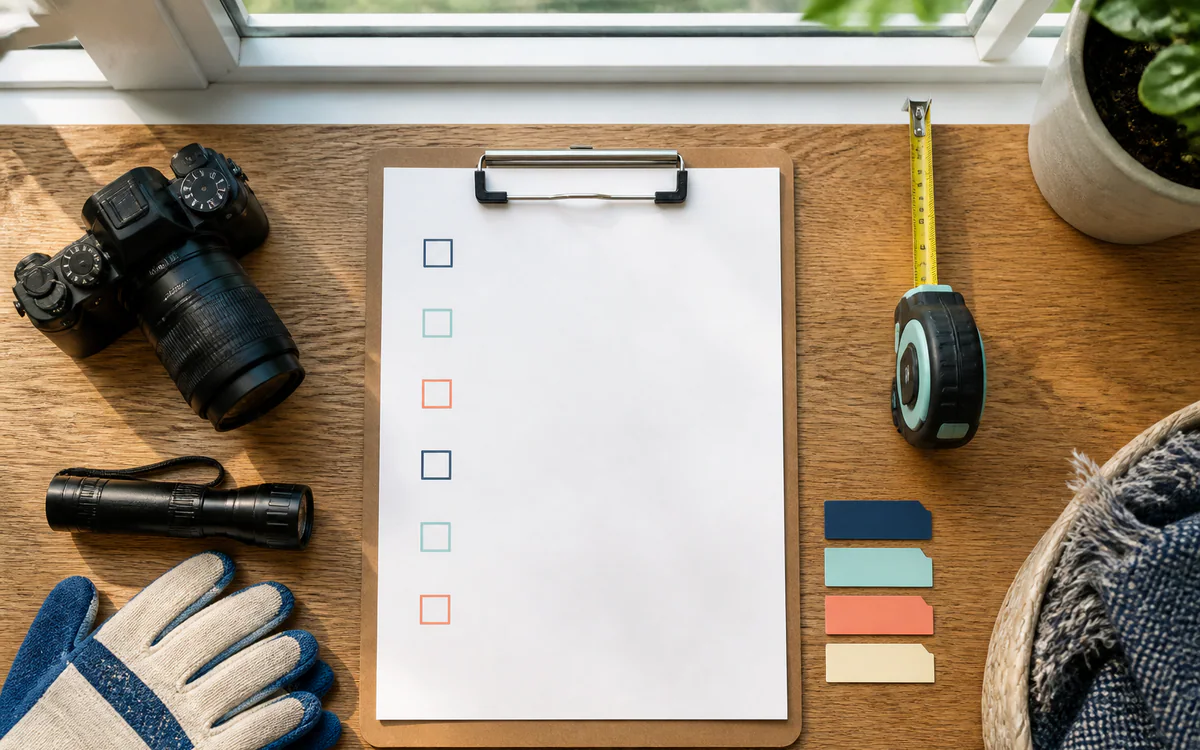
A useful checklist can include:
- Exact notice wording
- Cited section or reference
- Issuing office contact
- Date shown on notice
- Clarification asked for
- Owner-approved response
- Named firm
- Proof collected
- Filing receipt
- Office reply
Add “pending clarification” as a real status. It is safer than guessing. If a task requires legal, structural, environmental, electrical, plumbing, pest, or other trade knowledge, refer it to the right expert.
The cleanup planner can help organize private tasks. Pair it with the notice rather than replacing the notice. The Code Compliance Support service may assist with approved cleanup coordination and records, not official choices.
Use consistent photos. Record the area, angle, date, and task. A close-up without context may be hard to match later. Keep owner signoffs and vendor scopes beside the corresponding checklist line.
End every checklist with an official next step: proof sent, inspection asked for, response pending, or another status provided by the office. “Done” should mean the private task is complete, not that the case is closed.
What do you need for a code of compliance?
Rules for any certificate, signoff, or code choice depend on the jurisdiction, property, project, and official process. Ask the office named for the property. Use its forms and instructions. A private firm cannot supply a universal checklist or promise that sent work will be accepted. Related South Carolina planning tools include our code compliance cleanup support and code compliance documentation checklist.
The phrase “code of compliance” may not be the term used on your notice. Do not substitute a search phrase for the record’s wording. Ask the issuing office what outcome is available, what proof it needs, and whether an inspection or reinspection is part of the process.
Gather records without interpreting them
Useful project records may include:
- Notice as received and attachments
- Written office responses
- Owner signoffs
- Vendor scopes and invoices
- Dated before and after photos
- Filing receipts
- Inspection scheduling messages
- Final written determinations
This is a project sorting list, not a legal retention rule. The right expert should answer questions about which records must be kept and for how long.
The City of Charleston’s official Livability page provides city program context and contact details for properties within that jurisdiction. For another city or county, follow the office named on the notice. Procedures are not interchangeable.
If the office requests trade records, ask who is trained to prepare them. Do not ask an organizing or cleanup company to certify work outside its role. Keep private completion photos separate from any official inspection report.
When an owner lives elsewhere, identify one local access contact. That person can open the property and record visits, but should not make unauthorized choices. Put spending and scope limits in writing.
What is a code compliance inspection?
A code compliance inspection is an official review through the named office’s process. Scope, notice, access, proof, and results vary. A private cleanup walkthrough is not an official inspection and should not be presented as one. To turn this answer into a practical plan, compare code compliance cleanup support with the code compliance documentation checklist.
Use the notice or visit details to prepare. Confirm the date, access contact, areas expected to be accessible, and any requested records. Ask the office directly if you do not understand an instruction.
Keep preparation practical and neutral
Before the visit, review the checklist and make sure approved private work is recorded. Keep paths safe and access available where the people in charge have approved it. Do not hide open issues, move items without signoff, or coach a private vendor to speak for the owner.
Private prep may include:
- Confirm approved access.
- Organize project records.
- Review done scopes.
- Label open questions.
- Save filing receipts.
- Await official instructions.
The inspector or office controls the result. A vendor saying “looks good” is not acceptance. After the visit, record any official written direction and ask how to send more proof.
Do not call photos an inspection. Label them “owner project photos” with dates and locations. Do not edit images in a way that changes what they show.
If a tenant occupies the property, confirm access rights and procedures with the right expert. Code prep does not override privacy, lease, or legal obligations.
What are common mistakes to avoid in property preservation?
Common mistakes include acting without signoff, using vague scopes, discarding unclear items, hiding issues, mishandling items, and treating vendor work as official acceptance. Property preservation can have trade and legal meanings, so ask trained experts how it applies. For additional planning context, see code compliance cleanup support and the code compliance documentation checklist.
For a basic cleanup plan, the most preventable error is moving too fast. A due date can make every pile look disposable. Pause around records, valuables, family property, attached items, and anything with an unknown owner or next place.
Avoid scope drift
A cleanup firm should stop when work changes from approved sorting or loose-item handling into repair, demolition, environmental response, utility work, or another trade task. Get a new scope and a qualified firm for that task.
The EPA’s household hazardous waste guidance explains why some leftover household products need special care. Follow labels and local collection instructions. Never mix chemicals or pour unknown products into drains, soil, or basic containers.
Other mistakes include:
- Photographing private records
- Blocking utilities with stored boxes
- Losing the notice as received
- Missing change signoffs
- Using another jurisdiction’s checklist
- Promising a reinspection result
- Calling private notes official findings
Create a stop-work path. Anyone on the project should know who to call when ownership, safety, scope, or signoff rights are unclear.
Keep spending approval separate from trade scope. The owner can approve spending, but the qualified trade firm still defines its work method. The office controls official acceptance.
What is the most common building code violation?
There is no single violation that is most common in every South Carolina jurisdiction. Inspection priorities and records vary by office and property type. Use the actual notice to identify the cited issue, then ask the issuing office which rule, response, proof, and follow-up process apply. The next steps connect to our code compliance cleanup support and code compliance documentation checklist.
A checklist should not diagnose a property from a popular online list. It should make the official question easy to answer and keep private work tied to the cited area. General cleanup support cannot decide whether a building, electrical, plumbing, structural, or other technical condition violates a code.
Turn each cited item into an action line
For every notice item, record:
- Exact wording and location
- Issuing office contact
- Clarification requested
- Owner-approved next step
- Qualified firm, when needed
- Proof requested
- Submission date
- Office response
If the notice identifies several conditions, keep them separate. Clearing approved loose items from one area does not resolve a repair or technical question elsewhere. A photograph and invoice should be linked to the private task they document.
Ask the office which code title, edition, local provision, or written instruction applies when that detail matters. Do not borrow a checklist from another city. For Charleston properties, the city’s Livability page offers official contact and program context. Other South Carolina locations may use a different office and process.
Audit the checklist before every deadline
Read the notice as received again and compare each line with the working checklist. Look for a missing attachment, changed date, unclear status, or task that drifted beyond its original scope. Ask the office to clarify discrepancies. Do not “clean up” official wording for readability.
Check that every private task has an owner signoff and a firm suited to the work. A final photo should show the correct area and date. An invoice should match the approved scope. If proof is incomplete, mark it incomplete.
The audit should also confirm that private records do not expose unnecessary personal details. Remove account numbers from broadly shared copies when needed, store identity records securely, and avoid public photo links.
Create an exception page
Not every notice line will move smoothly. Use an exception page for an unavailable firm, unclear ownership, tenant access issue, suspected hazardous item, trade referral, weather delay, or office question. Give each exception a named contact and next contact date.
Do not bury exceptions in a green or complete status. The office needs an honest filing, and the owner needs a realistic project picture. A clear exception also helps trained experts understand what has already been attempted.
If an official date is approaching, contact the office through its stated method and ask about the process. Save the message and response. A private coordinator cannot grant more time or guarantee that a request will be accepted.
Close out without overclaiming
When private work is complete, archive the final scope, signoffs, photos, invoices, and filing receipt. Return keys, end short-term access, account for stored items, and remove vendor items from the site.
Keep the checklist active until the office communicates its result. If another visit or record is asked for, create a new dated line rather than editing the old history. The project record should show what happened in order.
Give the owner a closeout index that names where each record is stored and who can access it. Separate the private work file from the office’s official messages. This keeps a vendor invoice, a photo set, and an inspection result from being treated as interchangeable proof.
Review short-term access as part of closeout. Return keys, remove completed vendors from shared folders, and change access codes if the owner directs. Delete duplicate working copies that no longer serve a purpose, while preserving originals and required records under proper guidance.
Read the final index as if someone unfamiliar with the project will use it next month. Clear labels, dates, sources, and open statuses make the file useful without adding opinions about what an agency should decide.
Confirm where the notice as received and final office messages will be kept. A shared working folder may close, but the owner or authorized person still needs reliable access to the source records and open questions.
Write down who will check for the next reply and when. This keeps an open status from being lost after the last private visit.
If the office closes the matter, save that official message. If it does not, record the stated next step. Either way, the private team should describe only its own work and defer the official conclusion.
A strong checklist does not pretend to know the office’s answer. It preserves the original wording, records private work honestly, and makes the next official question easy to ask. That is the value of organized support.