
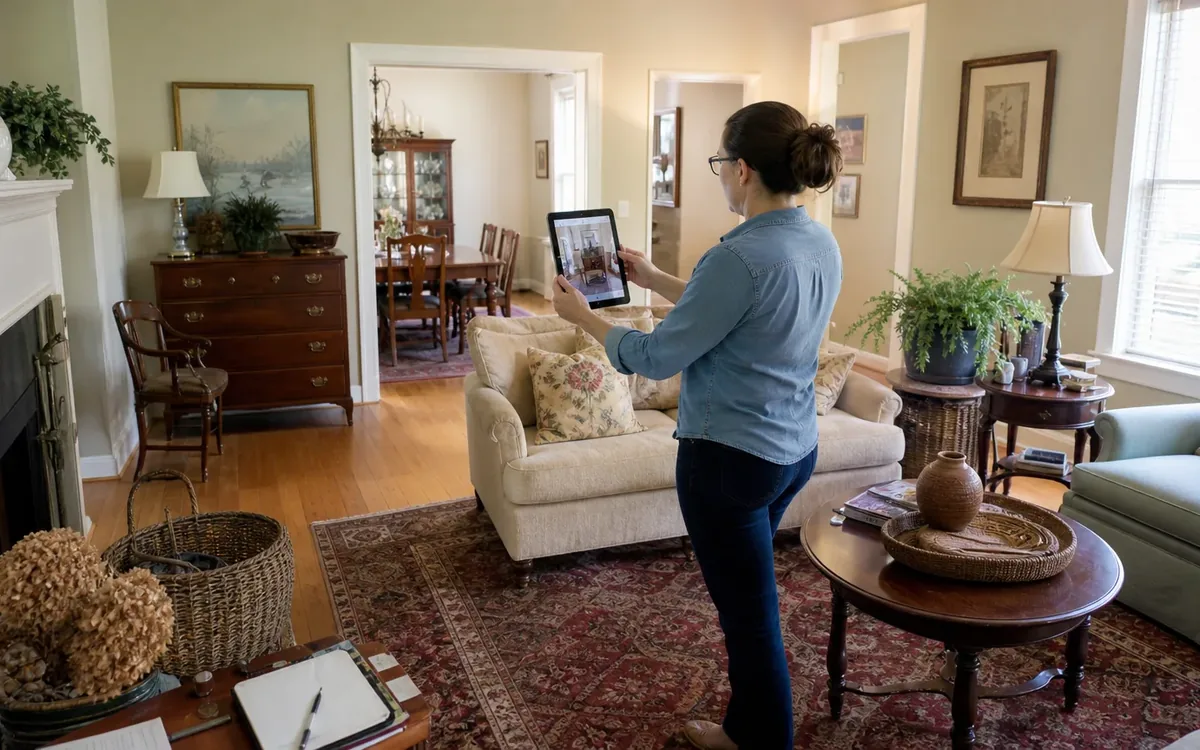
Photograph each room before moving anything, then record important items individually with a unique number, location, description, condition, and intended next step. Keep uncertain, valuable, sentimental, titled, or document-related property out of the removal stream until the authorized decision-maker and any necessary professional have reviewed it.
Quick answer: Start with wide room photos, continue with wall-by-wall views, and finish with close-ups of significant items and identifying details. Match every important item to a numbered inventory entry. Back up the files, document decisions, and obtain approval before removal begins.
This process is not a formal appraisal or a substitute for instructions from a personal representative, attorney, court, insurer, appraiser, or tax professional. Its purpose is to create an orderly visual record that supports informed decisions and reduces avoidable confusion during an estate transition.
What should happen before the first photograph?
Identify who has authority to direct the work. That may be a personal representative, executor, trustee, surviving owner, or another authorized person. Family agreement alone does not necessarily establish legal authority.
Ask the responsible person to define:
- Which rooms, buildings, vehicles, and storage areas are included
- Whether anyone may remove property before documentation
- Which beneficiaries or advisers need access to the inventory
- Whether a will, trust, court instruction, insurance matter, or family agreement affects handling
- Which items are already claimed, disputed, gifted, or excluded
- Whether an appraiser, auction professional, attorney, accountant, or real-estate professional must review anything first
Pause when authority is unclear. A cleanout or move team may discuss workflow, sorting zones, packing order, labor needs, and removal sequencing. It should not interpret estate documents, determine ownership, decide beneficiary rights, or provide a legal valuation.
Before starting, gather a charged phone or camera, charging cable, portable battery, measuring tape, removable labels, permanent marker, notepad, and a computer or secure drive for backups. Make sure the camera’s date and time are correct.
If the property will later be cleared, the estate cleanout service page can help the household understand the practical scope of sorting and removal. The photographs and inventory should come first, not after boxes and furniture have been shifted.

How should you photograph each room?
Use a repeatable route so another person can understand the space without being present. Start at the main entrance and work through the property in one direction. Include garages, sheds, attics, closets, porches, storage units, and other included areas, subject to safe access and the authorized scope.
For each room:
- Photograph the room name or place a temporary room label in the first frame.
- Take a wide image from the doorway.
- Take wide images from two or more corners.
- Move clockwise and photograph each wall.
- Open included closets and cabinets, then photograph their contents without rearranging them.
- Take medium-distance photos of furniture groups, shelves, and collections.
- Photograph individual items selected for inventory.
- Capture visible damage, stains, missing pieces, or unusual conditions.
Do not rely on one panoramic image. Panoramas can distort objects and make small contents difficult to identify. Overlapping standard photographs usually provide a clearer record.
Avoid applying filters or using portrait modes that blur the background. Check that labels and serial numbers are readable before continuing. If a reflective surface creates glare, change the angle instead of editing away details later.
A broader explanation of the overall transition appears in how estate cleanouts work. Use that guide to understand the larger process while keeping this documentation step separate from later sorting and removal.
Which items need individual inventory entries?
Not every spoon, paperback, or towel needs its own line. Record ordinary household goods in sensible groups, but create separate entries for property that may affect ownership, value, sentiment, security, or later decisions.
Common candidates include:
- Jewelry, watches, coins, and precious metals
- Artwork, signed pieces, and framed documents
- Antiques and distinctive furniture
- Collectibles, complete sets, and boxed collections
- Firearms, ammunition, and regulated items
- Vehicles, trailers, boats, and equipment with titles or serial numbers
- Electronics and devices that may contain personal data
- Safes, locked boxes, and unknown containers
- Financial records, tax files, deeds, titles, and estate papers
- Family photographs, correspondence, military items, and heirlooms
- Items specifically mentioned in estate documents or family instructions
- Property with visible maker’s marks, signatures, model numbers, or provenance records
- Anything claimed by more than one person
- Items whose significance or disposal requirements are uncertain
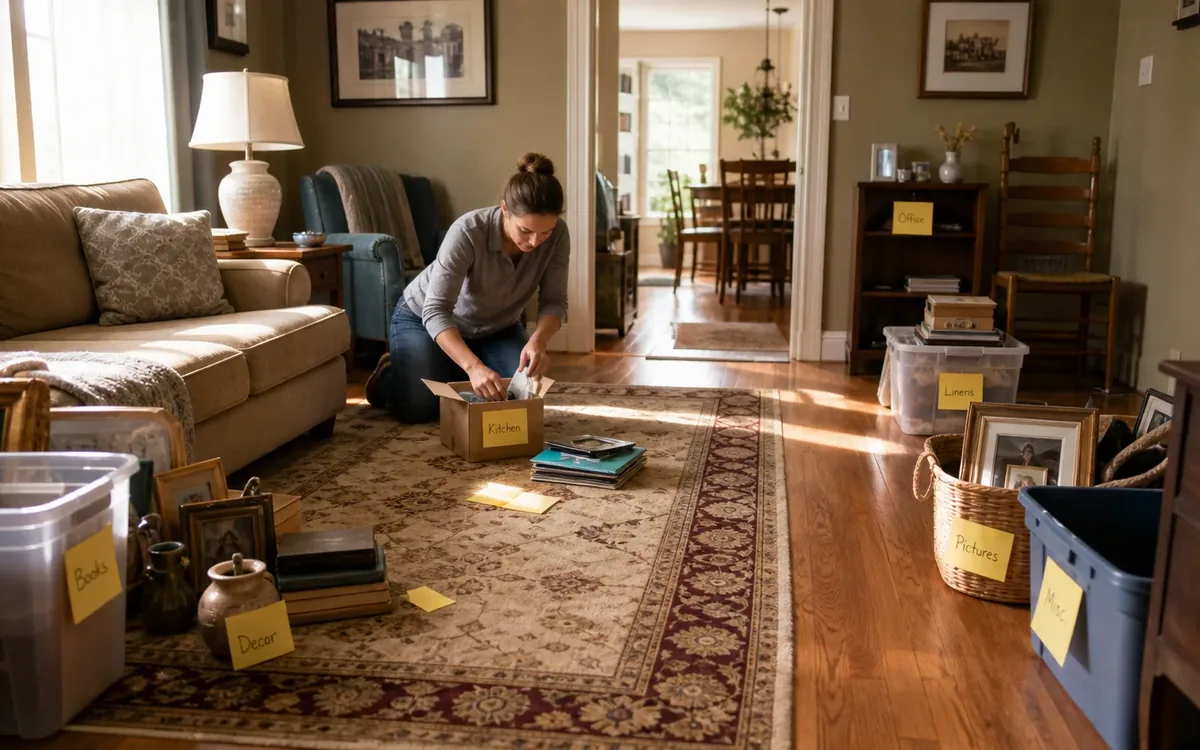
For groups of ordinary property, use entries such as “Kitchen utensils, two drawers” or “Guest-room linens, hall closet, three shelves.” Photograph the group in place and note its approximate quantity.
Do not label an item “valuable” based only on appearance. Use neutral terms such as “possible silver-colored serving set” or “signed landscape painting, signature not verified.” An appropriate appraiser, auction professional, dealer, or other qualified specialist determines market significance within their field.
What information belongs in the inventory?
A spreadsheet is usually easier to sort and share than handwritten pages. If paper is necessary, number the pages and photograph or scan them after each session.
Useful columns include:
- Item ID
- Date photographed
- Property address or estate reference
- Room and exact location
- Plain-language description
- Brand, maker, model, signature, or identifying mark
- Serial, title, or document reference, when appropriate
- Approximate quantity
- Visible condition
- Related photograph filenames
- Current status
- Intended next step
- Decision-maker and approval date
- Notes or unresolved questions
Use consistent IDs such as LR-001 for living room item 1 or GAR-014 for garage item 14. Place a removable label near the object, not on fragile finishes, paper, fabric, artwork, or surfaces that adhesive could damage. Include the label in at least one photograph.
Use factual condition language. Write “two-inch tear on right arm” rather than “bad condition,” and “device did not power on during visual inventory” rather than “broken.” Do not test machinery, firearms, electrical equipment, or unknown devices unless a qualified and authorized person determines that doing so is appropriate and safe.
A practical status field might use:
- Hold for authorized review
- Possible beneficiary distribution
- Appraisal or specialist review
- Auction or estate-sale review
- Retain with property
- Donate, pending approval
- Recycle, pending approval
- Remove, pending approval
- Ownership unresolved
The household can choose its record format and propose categories. The authorized decision-maker approves disposition. Legal ownership, tax treatment, formal valuation, regulated handling, and document interpretation remain with the relevant professional or authority.
How do you connect photographs to the inventory?
File naming matters more than camera sophistication. Rename files soon after each room, while locations are still fresh.
A simple convention is:
EstateReference_Room_ItemID_View_Date
For example:
OakStreet_DiningRoom_DR-006_MakerMark_2026-09-12.jpg
For every individually inventoried item, take:
- One image showing where it was found
- One full-item image
- Close-ups of identifying marks
- Close-ups of visible damage or wear
- An image of included accessories or components
- An image of the removable item-number label
Photograph collections both as a group and in smaller sections. If there are 40 pieces, use enough overlapping images to show what is present, then note whether the count is exact or approximate.
Avoid embedding sensitive information in filenames. A filename should not contain a Social Security number, complete account number, alarm code, medical detail, or full key code. Sensitive documents may require restricted access rather than inclusion in a broadly shared folder.
Do not delete imperfect images until confirming that a better version exists and has been backed up. Missing documentation is harder to correct after an item has left the property.
How should digital records be stored and shared?
Create one master folder with subfolders for room photographs, individual items, documents, approvals, and final disposition records. Keep an unchanged master copy and use a duplicate when adding notes or sharing selected files.
A practical folder structure is:
01_Room_Overviews02_Individual_Items03_Identifying_Details04_Documents_Restricted05_Approvals06_Disposition_Records
Maintain at least two backups in separate places, such as an encrypted cloud account and an external drive held by the authorized person. Access should be limited to people who need the records.
Be careful when photographs reveal addresses, keys, medications, account details, computer screens, security systems, or personal correspondence. Redacted sharing copies may be appropriate, but keep the unedited original under controlled access when the responsible person or advising professional says it should be retained.
Agree on one person to maintain the master inventory. Multiple uncontrolled copies can create conflicting statuses. Use version dates, and record who changed an item’s disposition and when.
Retention periods can depend on probate, tax, insurance, litigation, ownership, or professional advice. A cleanout team may retain operational records under its policies, but it should not decide how long the estate must preserve evidence or legal records. Ask the estate’s attorney, accountant, insurer, court, or other responsible authority when formal guidance is needed.
When should removal pause for professional review?
Stop the normal removal sequence when an item presents an unresolved question that could matter later. Place it in a clearly marked hold area, if safe, without changing its condition unnecessarily.
Professional review may be appropriate for:
- Property named in a will, trust, insurance schedule, or disputed claim
- Items that may warrant appraisal or specialized market review
- Firearms, ammunition, explosives, chemicals, fuel, or regulated materials
- Prescription medication and controlled substances
- Human remains, cremated remains, or memorial items
- Titles, deeds, financial papers, tax files, and original legal documents
- Computers, phones, drives, or devices containing private data
- Suspected mold, asbestos-containing material, structural hazards, or biohazards
- Items that may be stolen, culturally sensitive, historically significant, or subject to restrictions
- Locked containers when authorization to open them is uncertain
An appraiser addresses valuation within the scope of the assignment. An attorney or court addresses legal authority and disputes. A real-estate professional advises on market preparation and listing strategy. Inspectors and qualified contractors evaluate property conditions. Government agencies and regulated disposal channels determine applicable compliance requirements.
A practical team may point out visible concerns, create hold zones, move approved contents, and discuss sequencing. It should not authenticate objects, resolve title, diagnose hazardous materials, conduct a home inspection, or overrule a responsible professional.
How should the inventory guide the actual removal?
Freeze the inventory before removal day and generate working lists by status. Separate approved removals from holds, distributions, appraisal candidates, and property staying with the home.
Use visible zones or labels such as:
- Do not remove
- Authorized distribution
- Specialist review
- Approved donation
- Approved recycling
- Approved removal
At the start of removal, compare each zone with the master list. As items leave, record the date, destination category, authorizing person, and any available receipt or transfer record. For grouped household goods, a range of item IDs or a batch number can keep the record manageable.
Do not let verbal changes circulate through several people. Route changes to the person maintaining the inventory, then update the working list before the item moves. Photographing the final state of each cleared room can document completion, but those images do not replace the initial record.
For a South Carolina property transition, Clutter Cleaner of South Carolina may discuss estate cleanout logistics, move management, downsizing and organizing, auction or estate-sale pathways, home sale preparation, and code-compliance support where appropriate to the approved scope. The household and its authorized representative still control personal decisions, while regulated, legal, valuation, inspection, and real-estate judgments remain with the responsible professionals.
Common documentation mistakes to avoid
The most serious mistakes usually occur when documentation and decision-making happen at the same time. Keep them distinct: record first, review second, remove third.
Avoid:
- Starting after relatives have already removed items
- Photographing only individual valuables without room context
- Moving contents into piles before taking overview images
- Using vague filenames such as
IMG_4382 - Calling items authentic, rare, or worthless without qualified review
- Placing adhesive labels directly on delicate objects
- Sharing sensitive documents in an unrestricted family folder
- Treating silence as approval to discard
- Failing to record last-minute disposition changes
- Assuming a cleanout estimate is an appraisal
- Disposing of unknown chemicals or regulated property as ordinary trash
- Clearing sheds, attics, vehicles, or storage areas without confirming scope
If something has already been moved, photograph its current location, note who moved it if known, and record the original location as reported rather than established fact.
Short FAQ
Should every estate item be photographed separately?
No. Use room and group photographs for ordinary household goods. Create separate entries for significant, sensitive, disputed, titled, regulated, sentimental, or potentially marketable items.
Can family members decide what has no value?
The authorized household decision-maker can approve ordinary disposition within their authority. When value may affect distribution, taxes, insurance, sale strategy, or a dispute, seek an appropriate appraisal or market professional instead of guessing.
Should drawers and closed boxes be opened?
Only with authorization and when it is safe. Photograph the container before opening it, document contents in order, and stop if it contains weapons, hazardous material, sensitive records, remains, or property outside the approved scope.
Is a video walkthrough enough?
Usually not by itself. Video provides context, but still photographs and an indexed inventory make individual items easier to locate, review, and match to decisions.
When is the inventory finished?
It is ready for removal planning when included areas have been photographed, significant items have IDs, unresolved property is on hold, records are backed up, and the authorized decision-maker has approved the working disposition list.
A clear next step
Choose one room as a pilot before documenting the entire estate. Complete its overview photographs, item IDs, inventory entries, file names, backup, and review. Correct any confusion in the system, then use the same method throughout the property.
Once the record is complete, provide the authorized decision-maker with a master inventory, a restricted folder for sensitive material, a list of unresolved items, and a proposed removal sequence. Clutter Cleaner of South Carolina can be reached at (843) 972-7020 to discuss practical statewide estate-transition needs, while legal authority, appraisal conclusions, real-estate advice, inspections, and compliance determinations stay with the appropriate professional or public authority.



