

Organizing access for an estate cleanout means identifying who has authority over the property, inventorying every key and access device, limiting entry to approved people, and documenting each handoff. The household or legally authorized representative should establish those rules before cleanout work begins. A practical cleanout or move team may discuss working access, arrival procedures, and key return, but attorneys, courts, property managers, real-estate professionals, and other responsible authorities must resolve legal or professional access questions.
Quick answer: Name one access coordinator, confirm that person’s authority, create a key and device register, assign access only as needed, record every transfer, and collect or deactivate access when each person’s role ends. Do not rely on an unlabeled bowl of keys, a widely shared code, or verbal permission alone.
This guide focuses on control and documentation, not doorway dimensions, parking, or physical paths through the home. Its purpose is to help South Carolina households prevent confusion while relatives, cleanout workers, appraisers, real-estate professionals, contractors, and other authorized people may need entry for different reasons.
Who should control access to an estate property?
The person who controls entry should be someone with confirmed authority to act for the property or estate. Depending on the circumstances, that could be a personal representative, trustee, surviving owner, authorized family member, or another party recognized by the relevant documents or authority.
Family consensus is not always the same as legal authority. Possessing a key also does not establish a right to enter, remove belongings, change locks, or authorize another person. If authority is disputed or unclear, pause access decisions and consult the estate’s attorney or the appropriate court or authority.
Once authority is established, designate one access coordinator. That person can maintain the record even if another person physically meets workers at the property. Central coordination reduces duplicate keys, conflicting instructions, and uncertainty about who entered.
The household can decide practical matters within its authority, such as:
- Who will serve as the main contact
- Whether approved visitors receive a temporary key or escorted entry
- Where authorized keys are stored
- How arrivals and departures are recorded
- Which interior areas are restricted
- When temporary permissions end
A cleanout or move team may discuss which entrance workers should use, who will meet them, how alarms are handled, and where a provided key must be returned. The team should not decide who legally controls the estate or settle disagreements among heirs, beneficiaries, owners, tenants, or fiduciaries.
For broader project planning, review how estate cleanouts work before assigning access to anyone.
How do you build a complete key and access inventory?
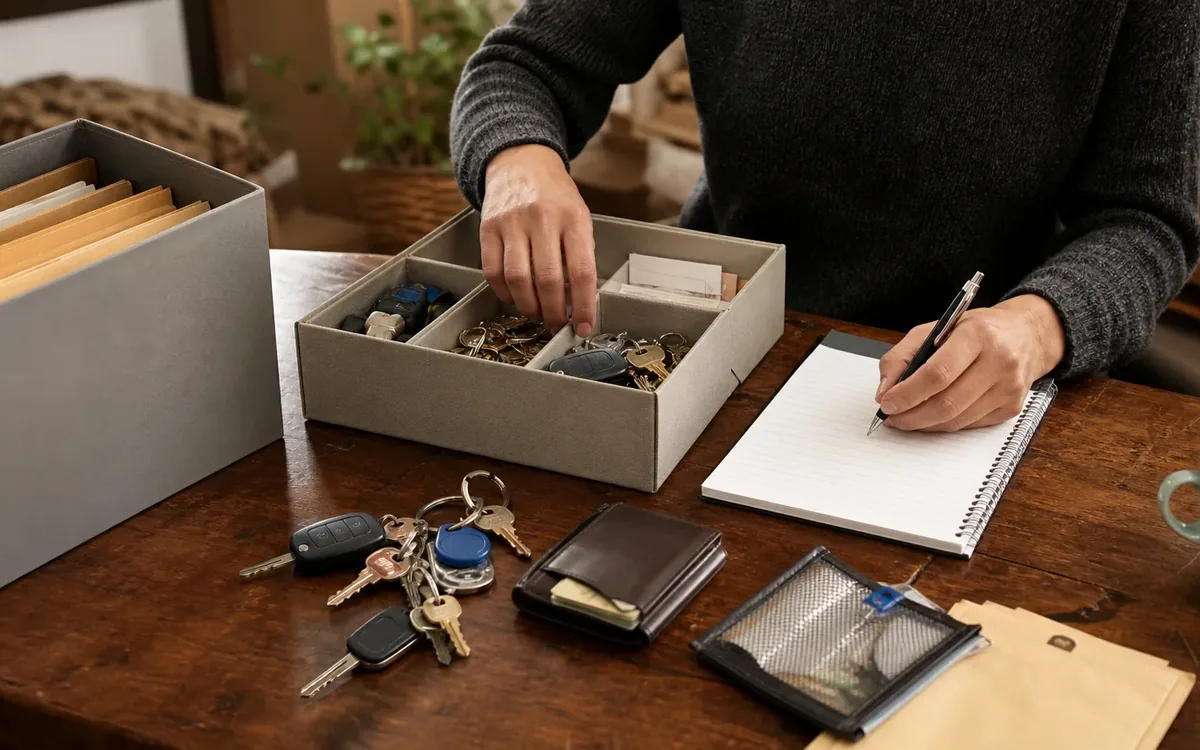
Start with a controlled collection process. Ask authorized family members and representatives to report every physical key, remote, card, code, app, and duplicated credential they know about. Do not immediately discard unidentified keys. An unfamiliar key may belong to a detached building, safe-deposit-related item, storage unit, vehicle, mailbox, cabinet, or security device.
Create a register with one row for each item or credential. Useful fields include:
- Unique label, such as K-01 or Remote-02
- What it opens or operates
- Current holder
- Number of known copies
- Date received or issued
- Restrictions on use
- Expected return point
- Final disposition, such as returned, transferred, or deactivated
Use removable tags that do not reveal the property address. A tag reading “Front Door, 14 Oak Street” creates unnecessary risk if the key is lost. “K-01, Main Entry” is enough when the corresponding record is stored securely.
Test keys only when the authorized representative permits it. Record the result rather than relying on memory. Keep uncertain items in a separate labeled group instead of mixing them with confirmed working keys.
Your inventory should account for more than house keys:
- Front, side, rear, and storm doors
- Deadbolts with separate keys
- Garage entry doors and overhead-door remotes
- Gates, fences, sheds, workshops, and detached structures
- Vehicles, trailers, boats, or equipment remaining on the property
- Lockboxes, safes, desks, filing cabinets, and display cabinets
- Mailbox or community access keys
- Alarm codes, keypad codes, smart locks, and mobile apps
- Storage-unit keys or credentials
- Building fobs, elevator access, or parking credentials where applicable
Do not force an unknown lock or open a container merely because a key fits. Ownership, privacy, firearm storage, controlled items, confidential records, and probate concerns may require direction from the authorized representative or an appropriate professional.
Households considering hands-on help can review the statewide estate cleanout service information while keeping authority and credential control with the proper decision-maker.
What information belongs in an access plan?
An access plan connects each approved person to a purpose. It should answer who may enter, why entry is needed, what areas are included, whether supervision is required, and how permission ends.
Build the plan around roles rather than informal assumptions. For example, a cleanout crew may need entry to agreed work areas, while an appraiser may need temporary access to selected belongings. A real-estate agent may need separate showing access, and a contractor may need entry only to evaluate or complete authorized work.
A practical plan covers six points:
- Authority: Identify the person approving access and the basis for that authority.
- Identity: Record the name, organization, and contact details of each approved entrant.
- Purpose: State why access is being granted, such as inventory, appraisal, cleanout, inspection, repair, or listing preparation.
- Scope: Note approved entrances, rooms, buildings, containers, and any restricted areas.
- Credential: Specify whether the person will be met onsite, receive a temporary key, or use another approved method.
- Closure: Define how the key, code, remote, or permission will be returned, transferred, or deactivated.
Keep alarm instructions separate from general scheduling messages. Share security details only with people who require them. If a smart-home account belonged to the deceased person, obtain appropriate guidance before attempting to reset ownership, passwords, or linked devices.
Avoid placing sensitive access information in a broad family group text. A controlled document or password-protected record gives the coordinator a clearer history and makes updates easier.
How should keys be handed to a cleanout or move team?
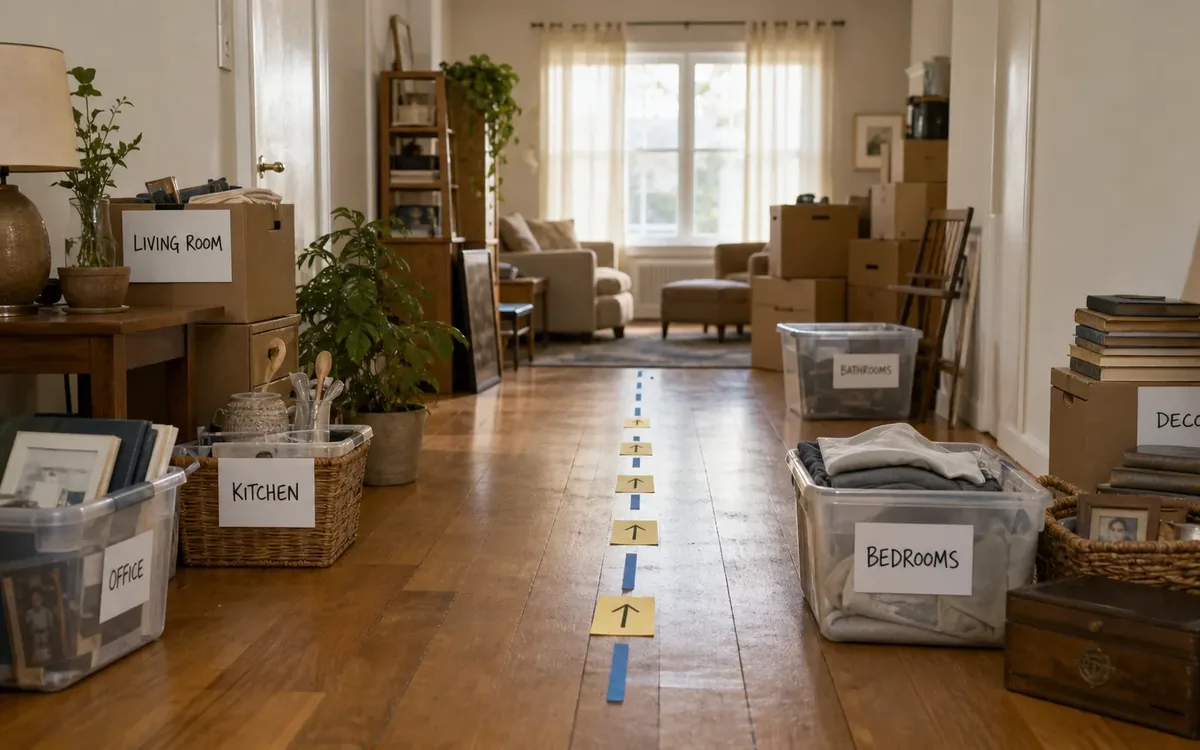
Use a documented handoff rather than hiding a key outside or sharing an unrestricted code. At the start, the access coordinator and team contact can verify which credential is being provided, the entrance it operates, any alarm procedure, and the expected return method.
A practical cleanout or move team may discuss:
- The entrance designated for workers
- Who will unlock and relock the property
- Whether the household will provide escorted entry
- Where a temporary key will be secured during approved work
- Which rooms or structures are outside the work scope
- How an access problem should be reported
- Who receives the key at handoff
The household or authorized representative decides whether the team receives a key at all. Escorted entry may be preferable when access authority is narrow, multiple parties are disputing decisions, or sensitive areas must remain closed.
If a key is transferred, record the label, recipient, date, purpose, and return. Both parties should understand that access to the building does not automatically authorize removal of every item inside it. Decisions about what stays, sells, transfers, donates, recycles, or enters an appropriate disposal stream should be separately approved.
Do not give all providers the same code simply because it is convenient. Separate credentials or supervised appointments make it easier to end one party’s access without disrupting everyone else.
Keep provider roles and decisions separate
Several professionals may visit an estate property, but they do not all make the same decisions. Clear role boundaries protect the estate and help prevent an access plan from becoming an informal transfer of authority.
Cleanout or move support: A practical team may discuss access logistics, agreed work areas, sorting instructions, item movement, and key return. It does not determine estate authority, ownership disputes, property value, title status, or legal rights of entry.
Storage: The household selects a storage provider and decides what may be stored, subject to its authority and the facility’s agreement. Storage access codes, unit keys, contracts, insurance choices, and account ownership remain separate household and provider matters.
Contractor work: A qualified contractor should define the work, site needs, and any permits or technical requirements within that contractor’s role. The authorized property representative approves entry and work. A cleanout team should not approve repairs or represent that work as compliant.
Appraisals: A qualified appraiser or relevant specialist determines appraisal methods and opinions of value. The household can arrange access and identify items for review, but the cleanout team should not substitute sorting observations for a professional appraisal.
Real estate and inspection: Real-estate professionals address listing, showing, transaction, and market matters within their roles. Inspectors address the inspections they are engaged to perform. They should establish their own access requirements with the authorized representative.
Disposal and regulated materials: The household can approve removal categories when authorized, while the appropriate facility, contractor, or authority determines acceptance and compliance requirements. Unknown chemicals, medications, firearms, documents, fuel, and other sensitive materials should not be treated as ordinary household discard without suitable guidance.
Legal authority: Attorneys, courts, governing documents, and relevant authorities address disputed authority, probate obligations, tenancy, title, and similar legal issues. A service provider cannot confer permission merely by accepting a key.
Prevent common access failures
Most access problems begin with informal habits. A spare key changes hands without a record, a code appears in an old message thread, or a relative invites a provider without telling the estate representative.
Watch for these warning signs:
- Keys are stored together without labels
- No one knows how many copies exist
- Several people claim to be the primary contact
- A lockbox code has been shared broadly
- Restricted rooms are marked only by verbal instruction
- Former caregivers, tenants, contractors, or neighbors may still hold credentials
- Smart locks or cameras remain linked to an unknown account
- Workers are told to admit other visitors
- A vehicle or storage key is assumed to belong with the house
- Final key return is not assigned to anyone
Correct the process without making unsupported accusations. Update the register, narrow distribution, and ask the authorized representative whether credentials should be changed. If there are signs of unauthorized entry, theft, coercion, or a dispute, preserve relevant records and seek direction from the proper professional or authority.
Security changes can have legal and practical consequences. A household should not change locks to exclude an occupant, co-owner, tenant, or other potentially entitled person without appropriate advice. A locksmith can address lock hardware, but the locksmith does not determine who has the legal right to authorize a change.
Manage access while work is underway
The access log should remain active throughout the project. It can be simple, but it should consistently record the person’s name, purpose, entry method, arrival, departure, and any key transfer or access problem.
Separate access notes from item decisions. An entry saying “appraiser visited upstairs rooms” does not establish that upstairs contents may be removed. Likewise, a contractor’s access to inspect a leak does not authorize cleanout of the surrounding room.
When instructions change, update the access plan and tell affected people directly. Examples include:
- A previously open room becomes restricted
- A family representative changes
- A key stops working
- An alarm procedure changes
- A provider’s role ends
- A property showing is scheduled
- A storage unit is added to the project
If multiple providers are present, avoid making one provider responsible for supervising another unless that arrangement has been deliberately approved and accepted. Each provider should have a clear contact and purpose.
The coordinator should also keep an incident note for missing keys, unlocked doors, alarm alerts, damaged locks, or unplanned visitors. Record observable facts rather than speculation. The authorized representative can then decide whether to contact a locksmith, attorney, insurer, law enforcement agency, property manager, or another appropriate party.
How do you close out and transfer access?
Access closeout should be a deliberate project step. Do not assume keys were returned because work appears complete. Compare every issued credential with the register and document its status.
Use this five-part closeout:
- Reconcile: Account for every key, remote, fob, card, and temporary credential.
- Recover: Collect items from relatives, workers, agents, contractors, and other approved holders whose access has ended.
- Deactivate: Have the authorized party address temporary codes, app users, lockbox credentials, and alarm permissions that are no longer needed.
- Transfer: Document which keys go to the owner, personal representative, buyer-side closing process, real-estate professional, property manager, or other authorized recipient.
- Archive: Retain the access register and handoff notes with appropriate estate or property records.
The household can decide how to package and label the final key set. The responsible real-estate professional, closing professional, attorney, property manager, buyer, or other authorized party should determine transaction-specific delivery requirements.
Before the final handoff, check detached structures, vehicles, cabinets, storage locations, remotes, and fobs. Keep unknown keys labeled as unknown rather than guessing. If the property will remain vacant, ask the insurer and relevant property professional about applicable security or policy requirements. They, not the cleanout team, interpret those requirements.
FAQ
Should every family member receive a key?
Not necessarily. The authorized representative can limit access according to each person’s role and applicable rights. Fewer distributed credentials usually make tracking simpler, but legal rights and governing documents must be respected.
Can a key be left in a lockbox for workers?
The authorized representative may choose a lockbox if appropriate. Control who receives the code, record the purpose, and change or deactivate access when that purpose ends. Real-estate or property-management rules may also apply.
What if nobody knows what a key opens?
Label it as unknown and keep it secure. Compare it with known locks only with authorization. Do not discard it until the representative has considered vehicles, storage, outbuildings, cabinets, mail access, and other possibilities.
Who decides whether locks should be changed?
The person with appropriate authority makes that decision, potentially with advice from an attorney, property manager, insurer, law enforcement agency, or locksmith depending on the issue. A cleanout team can report an access concern but should not make the legal determination.
What should happen if a key goes missing?
Document which key is missing, its last known holder, and what it opens. Notify the authorized representative promptly. That person can decide whether to deactivate a credential, consult a locksmith, preserve records, or contact the appropriate professional or authority.
A disciplined access record helps an estate cleanout proceed without confusing physical possession of a key with permission to act. Clutter Cleaner of South Carolina is based in Mount Pleasant, serves Charleston as its primary market, and has a statewide South Carolina service territory. Households can call (843) 972-7020 to discuss practical estate cleanout access needs, while reserving legal, valuation, transaction, inspection, contractor, and compliance decisions for the responsible professionals or authorities.



