

When several family members are preparing a home for sale, the most effective plan is to name one coordinator, confirm who has authority, agree on the sale goal, divide work by decision category, and record every choice in one shared system. Family members can sort belongings and set preferences, but the authorized owner or representative must approve property decisions. Agents, attorneys, appraisers, inspectors, contractors, and public authorities should handle conclusions within their own professional roles.
Quick answer: Create one written plan with five parts: decision authority, sale priorities, room-by-room status, assigned owners, and unresolved professional questions. Do not start clearing rooms until the family knows who may approve removal, sale, donation, storage, repairs, and listing decisions.
Why does one family coordinator matter?
A coordinator does not automatically gain authority over the house or its contents. The role is administrative: maintaining the plan, scheduling discussions, collecting answers, and making sure tasks do not disappear between relatives.
Without a coordinator, one sibling may call an agent while another schedules repairs and a third starts giving away furniture. Even when everyone means well, parallel decisions can create conflict, duplicate spending, or remove something another person intended to keep.
Choose someone who can communicate neutrally and use shared tools consistently. The best coordinator is not necessarily the oldest relative, the nearest relative, or the person with the strongest opinion.
Give the coordinator a defined scope, such as:
- Maintaining the master task list
- Recording decisions and open questions
- Scheduling family calls and property access
- Gathering proposals or professional recommendations
- Confirming that approvals came from the appropriate person
- Sharing updates in the agreed communication channel
The coordinator should not make unilateral legal, financial, repair, or disposal decisions unless that person already has documented authority to do so.
For practical help with sorting, organizing, move coordination, and sale-readiness tasks, families can review the statewide home sale preparation service. Service discussions should still be separated from decisions reserved for the property owner, authorized representative, or another qualified professional.

Who actually has authority to approve the work?
Establishing authority is the first gate in the plan. Family agreement is valuable, but consensus does not replace ownership rights, estate documents, court appointments, contracts, or professional advice.
The person responsible for confirming authority might be an individual owner, co-owner, trustee, personal representative, agent acting under a valid power of attorney, or another legally recognized party. The correct answer depends on the circumstances and documents.
If authority is unclear, pause irreversible work. A South Carolina attorney or the relevant court can address legal questions. A cleanout or move team may ask who can sign an agreement and approve the handling of contents, but it should not interpret wills, deeds, trusts, powers of attorney, probate documents, or court orders.
Create a simple authority note in the shared plan:
- Name of the person authorized to approve work
- Type of authority claimed
- Documents that may need professional review
- Other owners or representatives who must consent
- Decisions that remain temporarily restricted
- Attorney or responsible authority to contact with questions
Do not upload sensitive legal documents to a general family spreadsheet. Record where the documents are securely held and who may access them.
Authority over the real property may also differ from authority over personal belongings. Treat those as separate questions. If the home is part of an estate, the guide on when to start preparing to sell a house can help the family understand the operational sequence without substituting for legal advice.
What should the family decide before assigning tasks?
The household should agree on a limited set of practical priorities before turning the project into a room-by-room list. Otherwise, each person may work toward a different version of “ready for sale.”
Start with these six decisions:
- Define the objective. Decide whether the immediate goal is obtaining professional sale advice, reducing contents, preparing for photographs, accommodating repairs, or reaching another clearly stated milestone.
- Set preservation rules. Identify categories that no one may discard, donate, sell, move, or open without approval.
- Choose a communication system. Use one shared spreadsheet, project board, or document rather than scattered texts and private email chains.
- Adopt an approval rule. State which choices the coordinator may make and which require the authorized party, all owners, or professional guidance.
- Plan for disagreements. Move disputed belongings or proposals into a hold category instead of forcing an immediate decision.
- Identify outside questions. Separate issues for the real-estate agent, attorney, appraiser, inspector, contractor, tax adviser, insurer, utility provider, or public authority.
A real-estate professional can discuss buyer expectations, listing strategy, presentation, and market-related priorities. The family can decide how much labor, disruption, and personal involvement it is willing to accept. Those conversations inform one another, but they are not interchangeable.
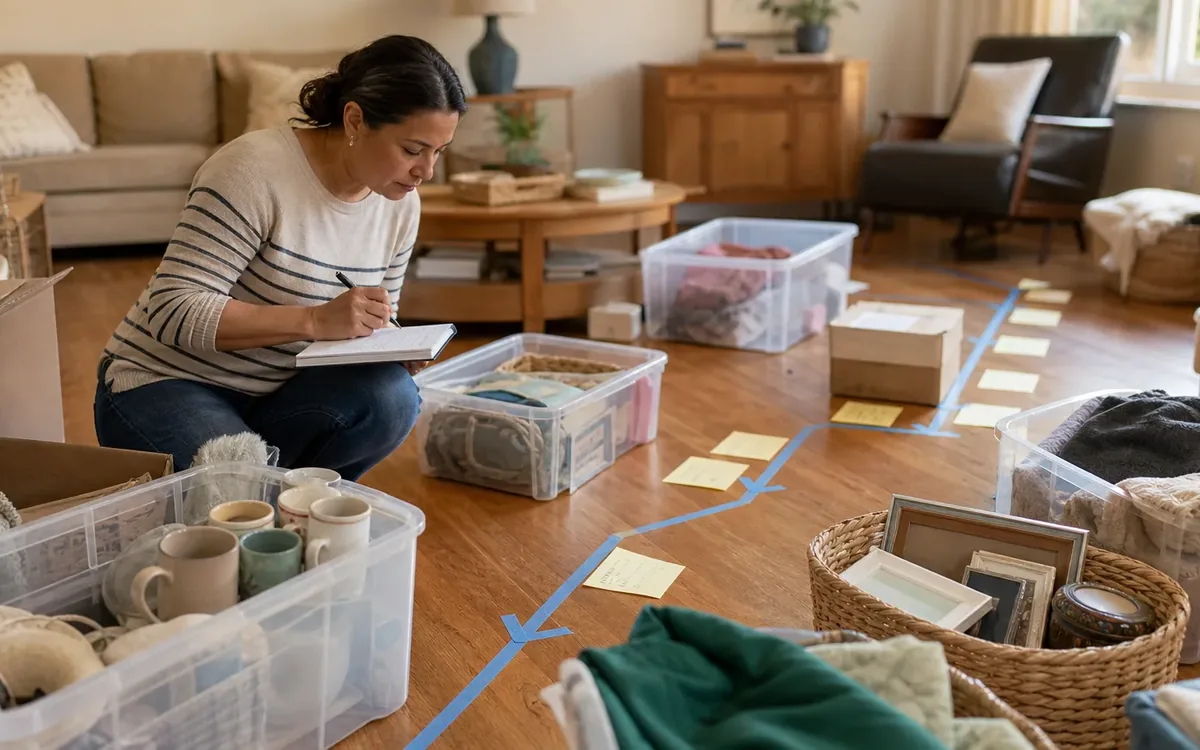
Build one plan around decisions, not personalities
Assigning “the kitchen to Alex” and “the garage to Morgan” sounds simple, but it can fail when every room contains legal papers, family keepsakes, valuables, trash, donations, and items intended for sale. A better structure sorts work by decision type while still tracking each room.
Use status labels that everyone understands:
- Keep in home: Needed until the move or approved for staging consideration
- Move: Going to the owner’s next residence
- Family review: Offered to relatives under an agreed process
- Appraisal question: Held for a qualified appraiser or appropriate specialist
- Possible sale: Pending a chosen auction, estate-sale, consignment, or other provider
- Donate: Approved for a selected recipient that accepts the item
- Dispose or recycle: Approved for an appropriate outlet
- Property fixture question: Not to be removed until ownership and listing implications are clarified
- Legal hold: Preserved because authority, ownership, records, or estate issues are unresolved
Then assign a named task owner and an approver. The task owner gathers information or performs approved work. The approver makes the final decision within their authority.
For example, one relative might photograph furniture and compile dimensions. The authorized representative decides whether it may leave the property. An appraiser evaluates value when an appraisal is warranted. A separate sale provider explains its acceptance criteria and process.
This structure reduces arguments about who is “in charge” because responsibility is attached to a specific action rather than to the whole project.
How can relatives coordinate when they live in different places?
Remote participation works best when information is consistent enough for someone to understand an item or issue without standing in the room. Random photographs and messages rarely provide enough context.
Create a repeatable record for each area:
- Room or storage location
- Item or task description
- Clear photographs, where appropriate
- Proposed disposition or action
- Person requesting the decision
- Person authorized to approve it
- Current status
- Professional input needed
- Final decision and date recorded
Use labels or item numbers for objects that could be confused. Photograph identifying details only when doing so is appropriate and secure. Avoid sharing account numbers, medical information, full legal records, keys, security codes, or identity documents through an open group link.
Schedule decision meetings around unresolved categories rather than giving a verbal tour of the entire house. A focused agenda might cover disputed furniture, papers requiring secure handling, contractor proposals, and belongings that may merit appraisal.
If someone cannot attend, establish whether the task should wait, whether that person can submit preferences in advance, or whether the authorized decision-maker may proceed. Silence should not automatically be treated as approval unless the group has formally adopted that rule and it is legally appropriate.
Separate belongings work from property work
Home sale preparation often stalls because contents decisions and property decisions become one combined list. Keep them on parallel tracks with different decision-makers.
Belongings track
The household or authorized representative can generally identify personal priorities, subject to ownership and estate constraints. A practical cleanout or move team may discuss sorting flow, packing categories, removal access, room sequencing, and the handling instructions it can accept.
Appraisals remain the work of qualified appraisers or relevant specialists chosen by the responsible party. Auction, estate-sale, consignment, donation, storage, recycling, and disposal options each have separate providers, acceptance rules, contracts, and costs. The family should select those paths rather than assuming every item has a market or a destination.
Property track
A real-estate agent can advise on listing presentation and sale strategy. An inspector reports conditions within the inspection scope. Contractors evaluate and perform work within their trades. Public authorities determine code or permit requirements. Attorneys address legal rights and obligations.
The household decides which recommendations to pursue, subject to contracts, applicable requirements, ownership authority, and professional advice. A preparation team can help organize access or discuss practical sequencing, but it does not replace an inspection, diagnose building conditions, set property value, approve permits, or guarantee compliance.
Storage is also a separate household choice. The family selects the facility or storage provider, reviews access and insurance terms, and decides what is worth storing. Moving items into storage postpones a disposition decision, so every stored category should have a named owner and review trigger.
Sequence the work to avoid doing it twice
A good sequence protects important material first and delays cosmetic effort until the home is sufficiently clear for informed decisions.
Use this seven-stage workflow:
- Confirm authority and restrictions. Resolve who may approve access, contents handling, contracts, and property work.
- Secure sensitive materials. Set aside identification, financial papers, medications, keys, legal records, photographs, digital devices, and items with personal data.
- Gather professional priorities. Ask the real-estate agent or other responsible professional what information is needed before the family commits to presentation or property work.
- Sort high-conflict categories. Address sentimental belongings, disputed ownership, valuable-looking items, and fixtures before routine removal.
- Reduce approved contents. Coordinate chosen recipients and providers for moving, family distribution, sale, donation, recycling, disposal, or storage.
- Evaluate property work. Let appropriate inspectors, contractors, authorities, or advisers address questions within their roles. The authorized party chooses among available options.
- Complete the final readiness review. Confirm that agreed rooms, access routes, documents, belongings, and approved work align with the listing plan.
Avoid painting around furniture that is leaving, moving boxes between rooms repeatedly, or scheduling photography before unresolved contents have been addressed. Also avoid removing attached items merely because a relative considers them personal. Ask the real-estate or legal professional responsible for clarifying whether an item is a fixture or personal property.
Create a disagreement process before conflict starts
Family members often attach different meanings to the same object or expense. A written pause process keeps disagreement from becoming an unauthorized action.
Use a “hold and resolve” rule. When someone objects, stop work on that specific item or decision, record the reason, and identify who can resolve it. Keep unrelated work moving when it is safe and authorized to do so.
Common resolution paths include:
- Ownership question to the authorized representative or attorney
- Value question to a qualified appraiser or relevant specialist
- Listing-impact question to the real-estate professional
- Condition question to an inspector or appropriate contractor
- Permit or code question to the applicable authority
- Family preference question to the agreed family decision process
- Provider-scope question directly to that provider
Do not ask a contractor to settle ownership, an appraiser to decide who inherits an object, or a cleanout team to resolve a legal dispute. Getting the right question to the right person is one of the coordinator’s most important duties.
Document the final outcome in neutral language. Record what was approved, by whom, and what happens next. Avoid using the project log to assign blame or repeat personal arguments.
What may a practical cleanout or move team discuss?
A practical team may discuss the physical workflow needed to carry out decisions that have already been authorized. Depending on the agreed service scope, topics may include:
- Which rooms or categories are included
- Access, parking, elevators, gates, and building rules
- Items the household has marked to remain
- Sorting or organizing support requested by the household
- Packing and move-coordination needs
- Removal sequence and destination instructions
- Safety concerns visible during the planned work
- Questions that must be referred back to the responsible person
Clutter Cleaner of South Carolina has a physical business location in Mount Pleasant and a statewide South Carolina service territory, with Charleston as its primary market. A service conversation can clarify whether requested estate cleanout, downsizing and organizing, auction or estate-sale, move management, home sale preparation, or code compliance support fits the available scope.
The team should not decide legal ownership, authenticate or appraise property, select repairs on the owner’s behalf, conduct a property inspection, determine listing price, issue permits, or declare that a property complies with law. Those decisions belong to the household’s authorized representative and the relevant professionals or authorities.
Keep the final handoff precise
Before the property moves into its listing or showing phase, prepare a concise handoff record. This is not a warranty that every issue has been resolved. It is a snapshot of what the family approved and what remains open.
Include:
- Areas cleared or organized under the plan
- Items intentionally remaining in the home
- Stored items and the person responsible for them
- Keys, remotes, manuals, and access information given to the proper person
- Contractor work reported as complete, pending, or declined
- Inspection, legal, appraisal, or compliance questions still open
- Documents held for the owner, representative, agent, or attorney
- Final contacts for unresolved belongings
Walk through the home using the same room names found in the shared plan. Check closets, cabinets, outdoor areas, attics, garages, and other accessible storage locations where applicable. Do not enter unsafe or restricted spaces solely to complete the checklist.
The authorized party should then confirm next steps with the real-estate professional. The agent determines what is needed for the listing process within the agent’s role, while the seller or authorized representative retains the decisions that belong to the owner.
Short FAQ
Should every family member approve every item?
Not necessarily. The family should establish an approval rule based on ownership, documented authority, and professional legal guidance where needed. Requiring universal approval for routine tasks can halt progress, while letting anyone act alone can create risk.
Should questionable valuables go into a sale pile?
No. Place them in an appraisal or specialist-review category until the authorized person selects the appropriate professional. Do not assume age, appearance, family stories, or online listings establish value.
Can the coordinator hire contractors?
Only if the coordinator has authority to enter that agreement or receives approval from the person who does. Contractors should define their own scope, qualifications, requirements, and terms. Permit and code decisions remain with the applicable authorities.
What should happen to items nobody can agree on?
Label and isolate them when practical, document the disagreement, and refer the issue to the authorized decision process. Storage may be considered by the household, but it is a separate provider choice and not a permanent resolution.
When should a family contact Clutter Cleaner of South Carolina?
Contact can begin once the family can identify the responsible decision-maker, the property location, the broad goal, and known restrictions. Call (843) 972-7020 to discuss whether the requested practical support fits the service scope. Legal, appraisal, inspection, real-estate, contractor, and compliance determinations remain with the appropriate professionals or authorities.



