

Coordinating a cleanout while the owner still lives in the home works best as a consent-led, room-by-room process, not a rapid whole-house purge. Protect daily routines first, establish who may approve each decision, and create separate destinations for items that stay, move, wait, or leave. The plan should let the owner continue using essential rooms safely while progress happens in controlled stages.
Quick answer: Begin with one low-conflict area and a written working agreement. Confirm access before every session, keep medications and daily necessities off-limits, use a temporary holding area for uncertain items, and obtain the owner’s approval before anything leaves. A practical cleanout or move team can help organize the workflow, but the owner or properly authorized decision-maker controls possessions and access.
Why an occupied-home cleanout needs a different plan
An empty property can often be divided into broad work zones. An occupied home cannot. Every room may still support eating, sleeping, bathing, mobility, pets, hobbies, medical routines, or contact with family.
The goal is therefore not simply to remove volume. It is to reduce clutter or prepare for a transition without making the home temporarily unlivable or taking control away from its occupant.
This distinction affects the sequence of work. Kitchens, bathrooms, bedrooms, entrances, and medication areas usually need tighter limits than a spare room or storage area. Even apparently unused belongings may carry emotional meaning or serve a purpose that is not obvious to another person.
Families considering professional help can review the statewide estate cleanout service while keeping the occupied-home safeguards in this guide at the center of the discussion. For background on the usual stages of a project, see how estate cleanouts work. An occupied-home plan should be narrower, slower, and more dependent on ongoing consent than a vacant-property project.

Who gets to make each decision?
Start by identifying the decision-maker before sorting anything. If the owner can and wishes to make decisions, relatives and helpers should not override those choices merely because they disagree about an item’s usefulness.
The household can decide:
- Which rooms may be entered and when
- Which cabinets, drawers, containers, or papers are private
- What the owner needs for daily living
- Which belongings stay in the home
- Which items may be offered to family, donated, sold, recycled, or discarded
- Whether uncertain items enter temporary storage
- How often breaks and decision sessions occur
- Who may receive project updates
A practical cleanout or move team may discuss:
- A room sequence and realistic work zones
- Sorting labels and container systems
- Paths for moving items through the home
- Temporary staging locations
- Packing and move coordination
- Options for auctions or estate sales when appropriate
- Home sale preparation tasks
- Questions or conditions that should be referred to specialists
The team should not decide ownership disputes, capacity, legal authority, market value, property condition, contract rights, or code compliance outcomes. Those matters stay with the responsible attorney, authorized fiduciary, qualified appraiser, real-estate professional, inspector, contractor, medical professional, government office, or other appropriate authority.
If relatives dispute who owns an item or who may authorize its removal, pause that item. Do not use the cleanout schedule to force a legal or family decision.
How do you protect consent throughout the project?
Treat consent as ongoing, specific, and reversible. Permission to work in the guest room on Tuesday is not automatic permission to open a bedroom closet on Thursday. Approval to sort a box is not necessarily approval to remove its contents from the property.
Use a brief written working agreement that records:
- The approved rooms and off-limits areas
- The names of people allowed inside
- Normal work hours and quiet periods
- Whether photographs are permitted
- Who can authorize removal
- Where uncertain belongings will wait
- How keys, alarm codes, and access instructions are handled
- When the plan will be reviewed
At the start of each session, ask whether access and room limits remain the same. At the end, review what is leaving and what remains unresolved. Use plain language and avoid presenting a decision as already made.
If the owner appears tired, distressed, confused, or pressured, stop the decision-heavy portion of the work. Family members can arrange a later session or seek appropriate professional guidance. A cleanout worker should not assess legal capacity or substitute personal judgment for medical or legal advice.
Build a room-by-room working map
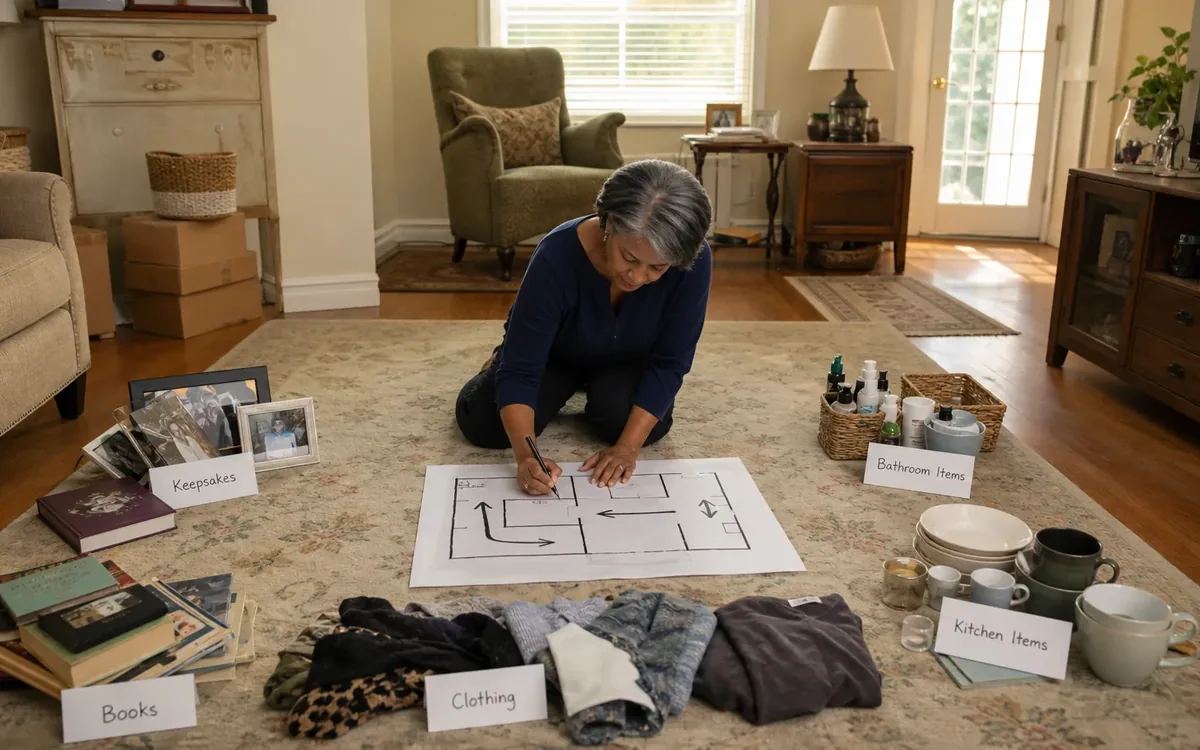
A working map prevents the project from spreading across the whole home. It can be a simple page listing each room, its current use, access limits, hazards to refer out, and its stage of completion.
Assign one of four statuses to every area:
- Protected: Essential to daily life and not available for sorting
- Active: Approved for work during the current session
- Holding: Used temporarily for labeled, unresolved belongings
- Complete: Reviewed by the owner and returned to usable condition
Only one or two rooms should usually be active at once. Opening many rooms creates unfinished piles, blocks pathways, and increases decision fatigue.
A practical sequence might begin with a lightly used room, then continue to a hallway closet, a secondary living area, and selected storage. The actual order should reflect the occupant’s routines and comfort, not a generic template.
For each active room, define a finish line. Examples include clearing one safe path, reducing one bookcase, emptying two approved cabinets, or preparing a specific group of items for a move. “Finish the room” is often too broad.
Restore the room at the end of every session. Remove work supplies, return furniture needed for daily use, and keep exits clear. Do not leave the owner surrounded by open boxes and unlabeled piles.
What should remain available every day?
Before any sorting starts, create a daily-use protection list. Ask the owner what must remain accessible, then verify the setup after each work period.
Common protected essentials include:
- Prescribed medications and health supplies
- Mobility devices, glasses, and hearing equipment
- Phone, chargers, emergency contacts, and alert devices
- Current identification and necessary financial materials
- Several changes of clothing and weather-appropriate outerwear
- Bedding, towels, and toiletries
- Pet food, leashes, carriers, and medications
- Frequently used cookware, dishes, and food
- Keys, remotes, calendars, and appointment information
- Sentimental objects the owner wants nearby
Keep these items in stable, clearly identified locations. Do not put medication, documents, keys, or mobility equipment into general sorting boxes.
Daily function includes movement through the home. Maintain usable routes between the bedroom, bathroom, kitchen, primary exit, and main sitting area. If a condition raises a safety, accessibility, electrical, structural, sanitation, or fire concern, the household should contact the appropriate professional or authority. A cleanout plan can keep work materials out of the way, but it does not replace an inspection or compliance determination.
Use temporary storage without creating a second problem
Temporary storage can protect consent by allowing an honest “not yet” decision. It becomes counterproductive, however, when everything uncertain is packed away without labels, limits, or a review date.
Create a holding system with three safeguards:
- A defined boundary. Use a specific section of a room, a fixed number of shelving units, or another agreed capacity.
- An inventory. Label containers with the owner, room of origin, broad contents, and date.
- A review point. Choose when and how the owner will reconsider the items.
Avoid labels such as “miscellaneous.” Better labels are “bedroom photographs, review with owner” or “kitchen serving pieces, family decision pending.” Do not place private documents or valuable items in an uncontrolled common holding zone.
Off-site storage involves additional decisions about cost, access, transportation, insurance, contracts, and eventual disposition. The household should evaluate those terms directly with the storage provider and any relevant insurer or adviser. A move team may discuss packing and transportation logistics, but it should not make financial or contractual choices for the owner.
Use a visible decision log for items that prompt repeated questions. Record the item, its location, who must decide, and the next step. This reduces pressure to settle difficult issues in the middle of a work session.
How can work happen without disrupting the owner’s routine?
Build the schedule around the owner rather than asking the owner to adapt to the project. Short, predictable sessions are usually easier to manage than long days with an uncertain stopping point.
Before scheduling, identify:
- Usual waking, meal, rest, and bedtime periods
- Medical appointments or in-home care visits
- Pet routines
- Times when the owner prefers quiet or privacy
- Rooms needed at specific hours
- Whether a trusted support person should attend
Separate decision sessions from physical work when helpful. The owner might make choices for 45 minutes, followed by packing or removal that does not require continuous input. This can reduce fatigue while preserving control.
Use a session rhythm:
- Confirm today’s area and limits.
- Review the previous decision log.
- Sort a small, defined group.
- Take scheduled breaks.
- Confirm every outgoing category.
- Restore daily-use areas.
- Record unresolved questions.
Never create urgency by saying a truck, buyer, donation destination, or property deadline leaves no time to reconsider. If a real deadline exists, explain it clearly and let the responsible person decide how to respond.
Plan how belongings will leave the home
An occupied home needs a controlled exit route. Identify the door, hallway, elevator if applicable, driveway area, and staging point before moving boxes or furniture. Keep the route separate from the owner’s resting area whenever possible.
Use distinct labels for each destination:
- Staying in the current room
- Moving to another room
- Moving with the owner
- Going to a named relative
- Being considered for sale
- Approved for donation
- Approved for recycling or disposal
- Waiting for professional review
The last category is useful for objects that may require an appraiser, hazardous-material specialist, document professional, electronics recycler, contractor, or another qualified resource. A cleanout team can flag a concern and pause handling. It should not authenticate valuables, set authoritative values, determine whether materials are hazardous, or declare that property complies with a rule.
Before removal, provide a simple review opportunity. This may be a written list, labeled group, or walk-through, depending on the owner’s preference. The key is that approval occurs before the items cross the threshold.
Keep communication respectful and useful
A cleanout can expose differences in memory, taste, finances, and family expectations. Neutral language helps keep the focus on decisions rather than judgment.
Instead of “Why are you keeping this?” ask:
- “What would you like to happen to this?”
- “Do you use this now, or should we place it in the review area?”
- “Is there someone you want to ask about this?”
- “Would a photo or written note help preserve its story?”
- “Should we stop here for today?”
Designate one family contact for routine logistics, but continue addressing the owner directly about the owner’s belongings when appropriate. Avoid group pressure, side conversations in the home, and removal plans the occupant has not heard.
Progress reports should be factual. Record rooms worked, containers moved, items awaiting decisions, protected areas, and the next approved step. Do not characterize the owner as difficult because they need time or change their mind.
Know when to pause and refer a question
Some issues do not belong inside a sorting decision. Pause and involve the appropriate person if the project uncovers:
- Disputed ownership or authority
- Documents that may affect legal or financial matters
- Items that may need a qualified appraisal
- Suspected hazardous materials
- Structural, electrical, plumbing, mold, pest, or sanitation concerns
- Questions about permits, local rules, or code compliance
- Proposed repairs or representations connected to a home sale
- Concerns about the owner’s welfare or decision-making capacity
Clutter Cleaner of South Carolina may discuss practical cleanout workflow, downsizing and organizing, move management, sale preparation, auctions or estate-sale options, and code compliance support within its statewide scope. Support means helping organize tasks or respond to known requirements. The responsible government authority determines compliance, while qualified legal, appraisal, real-estate, inspection, medical, and trade professionals make decisions within their fields.
Short FAQ
Should the owner leave during the cleanout?
Not necessarily. Some owners prefer to remain nearby, while others want a quiet place during physical removal. Decide based on comfort, safety, and how approvals will be obtained. Do not treat temporary absence as permission to enter new areas or remove additional belongings.
What if the owner changes their mind?
Pause the item if it has not left. Update labels and the decision log. The working agreement should explain what can happen if an item has already been transferred, sold, donated, or discarded, since recovery may not be possible.
How large should the first project area be?
Choose an area that can be sorted and restored in one session, such as one cabinet, one shelving unit, or part of a lightly used room. An early, contained success is more useful than several unfinished rooms.
Can family members approve removal for the owner?
Only the owner or someone with appropriate authority should approve it. A cleanout company should not determine whether a relative has legal authority. Direct uncertain authority questions to a qualified attorney or other responsible professional.
How can a household begin?
Write down the owner’s daily-use needs, select one low-conflict area, identify off-limits spaces, and choose a temporary holding zone. Then discuss those limits with any family members or practical cleanout team before work begins. Clutter Cleaner of South Carolina can be contacted at (843) 972-7020 to discuss project logistics within its statewide service territory.



