

Before home listing photos, remove or conceal documents, names, account details, screen content, and personal identifiers that could appear in the camera frame. South Carolina sellers should review each planned photo area with their agent, secure sensitive items separately from ordinary clutter, and request a privacy check before images are published. Protecting personal information is different from hiding property defects or omitting required disclosures.
Quick answer: Put paperwork and valuables in a secure, household-controlled location; remove visible names and identifying details; turn off screens and notifications; and review the actual photographs with your agent. Keep keys, medications, records, and passwords out of shared packing or donation areas. Ask the agent how corrections work if something private appears online.
What private information can listing photos reveal?
A room can look tidy while still exposing information. A single envelope on a counter may show a name and mailing address. A framed certificate may connect a resident to an employer. A calendar may reveal when the household expects to be away.
The camera also changes what matters. A wide room view can capture the desk beyond a doorway, a reflection in a mirror, or a document under a glass tabletop. High-resolution images may let viewers enlarge details that seemed insignificant during a walkthrough.
Look for these categories rather than simply looking for clutter:
- Identity: full names, signatures, birthdays, identification cards, and personal photographs with identifying captions.
- Financial information: bank statements, checks, tax records, account numbers, and payment notices.
- Health information: prescription labels, appointment paperwork, insurance cards, and medical equipment displaying patient details.
- Household routines: school schedules, work calendars, travel plans, and caregiver instructions.
- Access information: door codes, Wi-Fi passwords, spare-key labels, alarm instructions, and lockbox details.
The property address may already be part of the listing. That does not make every fact about the residents appropriate for publication. Aim to separate the information buyers need about the home from information they do not need about the household.
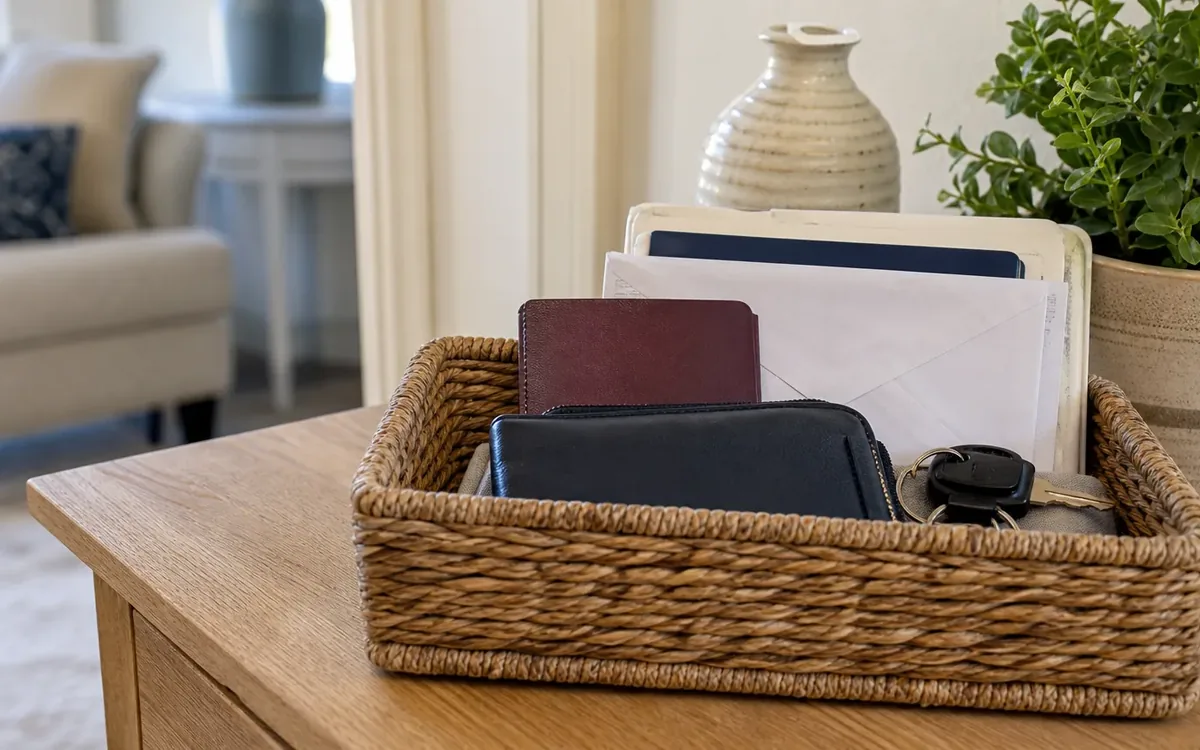
Establish a privacy boundary before preparation begins
Choose one secure destination for sensitive material before anyone starts sorting or moving items. This might be a locked cabinet outside the planned photo areas or another location controlled by the household. A closed cardboard box in a photographed room is not the same as secure storage.
Decide who can handle private records and who can approve their removal. In an occupied home, each resident should have an opportunity to identify personal items. In an estate or shared-ownership situation, the person with appropriate authority should direct decisions about records and belongings.
A useful set of household rules is:
- Private papers are not photographed, copied, donated, or discarded without approval.
- Sensitive containers receive neutral labels, not account names or medical descriptions.
- Keys, medication, identification, and essential documents stay under household control.
- Uncertain items go to a designated decision-maker rather than into a general removal pile.
For broader coordination, home sale preparation services can provide a starting point for discussing organizing and preparation needs. Tell any practical preparation team which items are off-limits and what handling instructions you expect before work begins.
How should you handle documents without losing important records?
Start with exposed paperwork, not every filing cabinet in the house. Counters, entry tables, bedside stands, refrigerators, and home-office surfaces are frequent places where sensitive documents remain visible.
Move records into clearly separated household categories:
- Needed during the sale: transaction correspondence and documents requested by the appropriate professional.
- Needed for daily life: identification, current medical information, bills, and appointment materials.
- Retain securely: records the household or its adviser determines should be kept.
- Review before disposal: papers whose ownership, importance, or retention requirements are unclear.
Do not use the photography appointment as a reason to destroy records hastily. Questions about tax retention, estate administration, ownership, or pending disputes belong with the appropriate attorney, accountant, fiduciary, or other responsible professional.
For estate households, the existing guide on how estate cleanouts work offers broader preparation context. Keep the privacy review distinct from the decision about whether an item can be sold, donated, transferred, or discarded.
If the household chooses document destruction, arrange it separately with a suitable provider and confirm the handling process. Ordinary recycling or trash may leave information readable. Neither moving a document out of view nor placing it in a disposal pile establishes that it has been securely destroyed.

Remove names and identifying details from ordinary objects
Personal information often appears on items that do not look like paperwork. Examine objects at eye level, on walls, and on open shelving. Pay attention to lettering that contrasts strongly with its background, since it can stand out in photographs.
Check for:
- Diplomas, professional certificates, awards, and framed licenses.
- Children’s artwork showing full names, school names, or classroom details.
- Sports jerseys, backpacks, uniforms, and personalized storage bins.
- Shipping labels on packages and addresses on magazine covers.
- Pet tags, luggage tags, and nameplates.
- Family photo arrangements that identify children or vulnerable residents.
The household can decide which personal images or names it is comfortable leaving visible. When several people live in the home, do not assume one person’s comfort applies to everyone. Consider whether a detail connects a resident to a school, workplace, medical condition, or regular destination.
Remove a sensitive object intact when possible instead of damaging it or improvising permanent alterations. If moving a framed item reveals a wall condition, ask the agent how to present the area honestly. Any repair or contractor work is a separate decision, not part of concealing information.
How do you keep screens and smart devices private?
Screens can reveal information even when nobody is actively using them. Notifications, calendar widgets, photo slideshows, video calls, and desktop file names may all appear in a room photograph.
Before photography, the household should decide how to manage each device:
- Power down televisions, monitors, tablets, and digital photo frames where practical.
- Disable visible notification previews if a device must remain on.
- Close documents and applications displaying personal information.
- Remove sticky notes with passwords or access instructions.
- Check smart displays for household calendars, contact names, or camera feeds.
Do not give a preparation team account credentials merely to make a screen look neutral. A household member can manage device settings. If equipment must remain active for accessibility, medical, security, or work reasons, discuss a suitable camera angle with the photographer and agent.
A powered-off screen can still reflect nearby paperwork or people. Check reflective monitors, mirrors, glossy cabinet doors, and glass frames from the expected camera position. This is especially important where a home office opens into another photographed room.
Do not disable safety equipment or necessary monitoring simply for appearance. If private information cannot be concealed safely, ask about excluding that view or handling the image through the agent’s photography process.
Review the camera’s view, not just the room
Walk through the planned photography route with a phone camera if that is practical. The purpose is to spot privacy exposures, not to create substitute listing images. Use the likely doorway or corner position and examine the resulting view at a larger size.
Inspect the edges of the frame as carefully as the center. An open door may reveal records in another room. A kitchen shot may include the refrigerator calendar. A bedroom mirror may show a dresser surface behind the camera.
Exterior views deserve a privacy check too. Look for vehicle plates, delivery packages, named yard signs, school decals, and labels near entrances. Ask the agent which exterior features should remain visible to represent the property accurately.
Avoid creating a new exposure while documenting the old one. If your test photograph contains readable information, do not send it casually to a group chat or upload it to a shared preparation folder. Describe the location of the concern instead, or share only through a process the household considers appropriate.
Where moving an item would be unsafe or impractical, flag the exact issue for the photographer. A general instruction to “make everything private” is less useful than identifying the certificate above the desk or the medical label beside the bed.
Coordinate household choices with the right professionals
A practical cleanout, organizing, or move team may discuss where belongings should go, which containers need special handling, and how to keep private items separate during preparation. The household should provide clear directions and identify the person authorized to answer questions.
Clutter Cleaner of South Carolina is physically located in Mount Pleasant, with Charleston as its primary market and a service territory covering all of South Carolina. Its approved services include home sale preparation, downsizing and organizing, estate cleanouts, and move management. A privacy-focused conversation should clarify the requested preparation tasks and handling boundaries rather than assume document security services are included.
Keep these decisions with the appropriate parties:
- Household or authorized representative: access to personal belongings, preferred privacy boundaries, and approved handling instructions.
- Real-estate agent: listing presentation, photography coordination, image publication, and questions about accurate marketing.
- Attorney or responsible authority: legal duties, authority over estate records, disputes, and disclosure obligations.
- Appraiser: valuation questions about potentially significant belongings.
- Inspector or relevant compliance professional: property-condition and compliance assessments.
Storage arrangements, contractor repairs, appraisals, and disposal methods are separate household or provider choices. Removing identifying information does not resolve a property condition, establish legal authority, or replace professional review.
Check the finished images before publication
Ask your agent whether the household can review the selected images for privacy concerns before publication. Clarify how to flag an image and who will decide whether it should be replaced, reframed, or edited. Do not assume every image will be available for advance review.
When reviewing, enlarge areas containing text, reflections, desk surfaces, refrigerator doors, and screens. Include alternate room views and any virtual-tour material. Check that an item removed for one photograph did not reappear elsewhere.
If editing is proposed, distinguish obscuring a personal identifier from altering the home’s condition or features. The agent and photographer should determine an appropriate approach that preserves an accurate representation of the property.
If something private is published, contact the agent promptly with the image and exact concern. Ask about correction and distribution to other listing outlets. Removing the original image may not remove copies already saved or shared, which is why prevention matters.
Short FAQ
Is turning documents face down enough?
Not always. Other pages, envelope windows, reflections, or a later shift in position can expose information. Moving papers to secure household-controlled storage is more reliable.
Should all family photographs be removed?
That is a household choice. Consider consent and identifying details, especially for children. Remove images the residents do not want distributed publicly.
Can private information simply be blurred later?
Ask the agent and photographer, but do not rely on editing as the only safeguard. Removing the information before capture reduces the chance of an overlooked exposure.
Who decides whether estate paperwork can be discarded?
The appropriately authorized person, with professional advice when needed. A photo-preparation deadline does not establish permission to destroy records.



