

Planning an estate cleanout in a condo or apartment building starts with the property’s rules, not with removing furniture. Before anyone carries items through a hallway, the household should confirm permitted work hours, elevator reservations, loading access, insurance requirements, parking limits, and common-area protection with the HOA, building manager, landlord, or other responsible authority.
Quick answer: Get the building’s written move-out or vendor rules, identify who can authorize access, reserve required facilities, sort the estate before the removal date, and give every participating provider the same instructions. The household controls decisions about belongings, while the building controls access and common areas. Legal representatives, appraisers, real-estate professionals, inspectors, and compliance authorities retain decisions within their respective roles.
This distinction matters in Charleston, Mount Pleasant, and other coastal South Carolina communities, where condos and apartments may have controlled entrances, shared elevators, narrow corridors, parking restrictions, or association procedures. A practical plan treats the building as an active part of the project rather than as a passive location.
Why does a condo estate cleanout require a different plan?
A detached home may have a private driveway and several direct exits. A condo or apartment usually places the work inside a shared system. Furniture may need to pass through resident hallways, a service elevator, a lobby, a loading area, or a secured gate.
That creates three separate layers of responsibility:
- The household or authorized representative decides what may be kept, transferred, sold, donated, recycled, stored, or discarded.
- The building authority decides how vendors enter, where vehicles may stand, which elevator can be used, and what protection or documentation is required.
- Specialized professionals decide matters involving legal authority, valuation, contracts, real estate, inspections, hazardous materials, or government compliance.
Do not assume that rules used for an ordinary household move also apply to an estate cleanout. Removal may involve several destinations, multiple providers, or items that require special handling. Ask for the current written policy rather than relying on a resident’s memory or a prior contractor’s experience.
If the family is still defining the overall process, the guide on how estate cleanouts work explains the broader sequence of authorization, sorting, distribution, and removal. For help focused on clearing estate contents, review the statewide estate cleanout service.

Who has authority to approve the cleanout?
Before arranging building access, establish who may make decisions for the estate. That person could be an executor, personal representative, trustee, property owner, or another legally authorized party. Family involvement alone does not establish legal authority.
The household can gather records and identify the person who appears responsible. Questions about probate authority, ownership, beneficiary rights, disputed property, leases, or required notices belong with a qualified attorney, court, landlord, association, or other responsible authority. A cleanout or move team should not decide who owns an item or interpret estate documents.
The authorized person should identify:
- Who can sign building forms and provider agreements.
- Who can approve each item’s destination.
- Who receives questions during the work.
- Who has keys, entry credentials, and alarm instructions.
- Who will inspect the unit after contents are removed.
If several relatives are participating, designate one operational contact. Other family members can still contribute, but conflicting directions at an elevator or loading area can stop work and increase the chance of a mistaken removal.
Keep written records of major disposition decisions. Label items that must remain in the unit, especially fixtures, leased equipment, documents, keys, remotes, building credentials, and property belonging to another resident or the association.
What building rules should you confirm before scheduling?
Request the building’s current move, delivery, or vendor packet. If no formal packet exists, ask the manager or landlord to confirm requirements in writing. The relevant rules may come from an HOA, condominium association, property manager, building owner, lease, or security office.
Confirm these subjects:
- Permitted days and hours for removal activity
- Whether an elevator reservation is required
- Whether the service elevator must be used
- Loading-zone location and vehicle restrictions
- Parking rules for workers and family members
- Gate, loading dock, concierge, or security procedures
- Vendor registration or insurance documentation
- Deposits, access fees, or damage procedures imposed by the building
- Required floor, wall, doorway, or elevator protection
- Limits on carts, dollies, or equipment
- Rules for bulky furniture, mattresses, appliances, and electronics
- Restrictions on using resident trash rooms or shared dumpsters
- Procedures for keys, fobs, passes, and elevator controls
- Requirements for cleanup of corridors, elevators, and loading areas
The building authority decides what its property rules require and whether submitted documentation is acceptable. A cleanout provider may discuss equipment, crew access, vehicle placement, and the planned flow of contents, but cannot waive an association rule or promise that management will approve an arrangement.
Ask how changes are handled. If an elevator becomes unavailable or the loading space is blocked, determine who has authority to provide an alternative. The plan should not depend on workers improvising in restricted common areas.
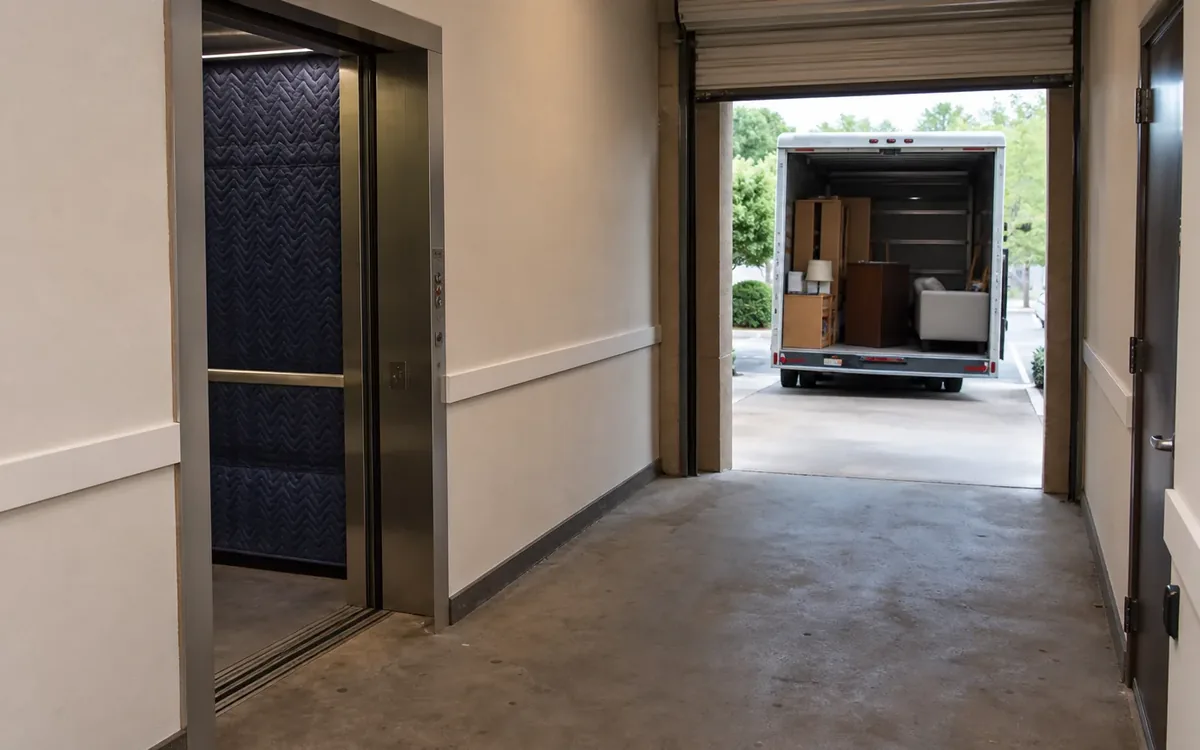
How should elevator and loading access be coordinated?
Treat the path from the unit to the vehicle as a single controlled route. Walk it before the project if access permits. Look for turns, door widths, steps, thresholds, low fixtures, sprinkler heads, security doors, and places where residents may need to pass.
A useful route review covers five points:
- Unit exit: Confirm that large items can leave without altering doors or building components.
- Hallway route: Identify corners, carpeted areas, resident doors, and fire equipment that must remain unobstructed.
- Elevator access: Verify the reserved elevator, control procedure, dimensions, weight rules, and required padding with management.
- Building exit: Check door controls, ramps, dock access, and any limits on propping doors open.
- Vehicle position: Confirm the approved loading location and whether vehicles must move between loads.
The building should address elevator operation and occupancy rules. The household and cleanout team can discuss how to stage items inside the unit so the reserved access is used efficiently. Staging should never block an exit, fire equipment, another unit, or a common corridor.
Do not place unapproved items in a lobby, hallway, stairwell, loading dock, curb area, or shared trash enclosure while waiting for a decision. Sort within the unit or another approved space. If the unit is too crowded to establish a safe working lane, discuss a phased approach with the team and building management.
Protect common areas without losing control of the estate
Common-area protection is both a building concern and a practical risk-control step. Management may specify materials or installation methods for floors, walls, elevator interiors, and doors. Follow those instructions rather than assuming cardboard, plastic, tape, or blankets are acceptable everywhere.
Before removal begins, consider documenting the approved route with dated photos. Include existing marks or damage that could later be confused with cleanout activity. Ask building management whether a pre-work walkthrough or post-work check is required.
A practical team may discuss:
- Protective coverings permitted by the building
- Carts or dollies suited to the route
- Furniture disassembly needed for safe passage
- In-unit staging zones
- How workers will keep doors secure
- How loose contents will be contained
- Final sweeping or debris pickup along the used route
The building remains responsible for interpreting its common-area rules. Contractors should make their own decisions about work methods within their trade and agreement. For example, removing built-in cabinetry, disconnecting appliances, repairing walls, or altering doors may require a separate qualified contractor and building approval. Those tasks should not be treated as ordinary contents removal.
Someone should monitor the route while items are moving. That person can pause traffic for residents, check protection, and prevent boxes from being left in shared spaces. Courtesy also matters: avoid taking over resident elevators or entrances beyond what management has approved.
Sort inside the unit before items reach the elevator
An estate cleanout becomes harder when disposition decisions are made in the hallway or at the truck. Create clearly marked in-unit zones before removal. The labels should describe an approved destination, not merely indicate that someone will decide later.
Useful categories can include:
- Keep with family
- Deliver to a named recipient
- Appraisal review
- Estate sale or auction review
- Donation review
- Storage
- Recycling or regulated disposal review
- Approved discard
- Remain with the property
Keep personal papers, financial records, photographs, jewelry, medication, keys, firearms, and potentially hazardous materials out of general removal piles until the authorized person decides the correct next step. Sensitive records may require secure handling rather than ordinary disposal.
An appraiser determines value within the scope of an appraisal assignment. An auctioneer or estate sale professional decides what they will accept and under what agreement. A storage company controls its contract and facility requirements. Donation organizations decide what they accept. Waste facilities and public authorities determine disposal rules for regulated or restricted materials.
A cleanout team may help the authorized household carry out documented decisions and discuss practical separation of contents. It should not make legal ownership decisions, guarantee resale value, or represent that every item can go to the family’s preferred destination.
For a broader decision framework, see the best way to clean out an estate. In a multifamily building, apply that framework inside the unit before shared access begins.
Build one access plan for every participating provider
Estate projects often involve more than one provider. An appraiser may review valuables, an estate sale or auction professional may select marketable property, a mover may transport family items, a storage company may receive retained contents, and a cleanout team may remove approved remaining material.
Do not assume one provider’s elevator reservation covers another. Give each provider the written building instructions and ask management whether separate registrations or reservations apply.
Create a shared access sheet containing:
- Building address and unit number
- Authorized household contact
- Building management or security contact
- Approved entrance and loading area
- Parking instructions
- Elevator reservation details
- Access credential procedure
- Common-area protection requirements
- Restricted items or activities
- Unit areas that are off limits
- Approved destinations for contents
- Procedure for reporting damage or access problems
Avoid publishing access codes in a broad family message or on an unsecured label. Limit credentials to people who need them and follow the building’s security instructions. Return fobs, keys, elevator locks, and passes as directed.
If contractor work is needed, schedule it as a separate scope unless the responsible providers and building approve otherwise. Appliance disconnection, repairs, painting, flooring, pest treatment, mold work, and structural changes are not automatically part of a cleanout. The relevant contractor determines its methods, while the owner, association, permit office, or other authority decides applicable approvals.
What happens after the contents are removed?
Removal is not necessarily the final step. The authorized person should inspect the unit and verify that items intended to remain are still present. Compare the result with the building’s move-out requirements and any real-estate or lease obligations.
The final review may include:
- Closets, cabinets, drawers, balcony areas, and storage lockers
- Mailbox, garage, parking, or amenity credentials
- Keys, remotes, manuals, and appliance accessories
- Items attached to walls or treated as fixtures
- Personal records missed during sorting
- Condition of the elevator and removal route
- Debris in loading or common areas
- Building forms requiring completion
Questions about whether an item is a fixture or personal property should go to the relevant real-estate or legal professional. A real-estate agent can advise within the agent’s role about market preparation and transaction expectations. A licensed inspector evaluates property conditions within the inspection scope. Government or association authorities decide code and compliance requirements.
Clutter Cleaner of South Carolina lists home sale preparation and code compliance support among its services, but support does not replace an official inspection, legal opinion, association decision, permit review, or government determination. The household should obtain the appropriate professional decision before authorizing corrective work or disposal tied to compliance.
After the route is clear, follow the building’s procedure for reporting damage, removing protection, returning access devices, and closing reservations. Keep copies of approvals, disposition records, provider agreements, and building correspondence with the estate file.
Common planning mistakes to avoid
Several preventable mistakes create difficulty in multifamily properties:
- Booking a team before checking permitted removal hours
- Assuming a passenger elevator can be used for furniture
- Sending several providers under one unconfirmed reservation
- Using a shared dumpster without written permission
- Leaving donation or discard piles in a corridor
- Removing items before legal authority is clear
- Mixing appraisal candidates with approved disposal
- Treating storage as a temporary answer without naming who controls the account
- Scheduling contractor work without management approval
- Forgetting a separate storage locker, garage space, or mailbox
- Promising a buyer, beneficiary, or charity an item before confirming ownership and acceptance
- Leaving keys or access credentials with an unauthorized person
The strongest plan keeps three records aligned: what the estate authorizes, what the building permits, and what each provider has agreed to do. If those records conflict, resolve the issue before material begins moving.
Short FAQ
Can a cleanout use the building’s regular trash or dumpster?
Only if the building expressly permits it and the items comply with its rules and applicable disposal requirements. Ask management about volume limits, prohibited materials, and bulky-item procedures. The relevant facility or authority controls acceptance.
Who reserves the elevator?
The building’s policy determines who may make the reservation. It may be the owner, tenant, authorized estate representative, or registered provider. Confirm the named reservation holder and access procedure in writing.
Should valuable items be removed first?
Secure financial records, jewelry, collectibles, keys, and other sensitive property early, but do not distribute or sell items until the authorized person has approved that action. Use a qualified appraiser when an appraisal is needed.
Can furniture be left in the hallway while the unit is sorted?
Usually this is a matter for building management, fire-safety rules, and other applicable authorities. Do not use common areas for staging unless written permission specifically allows it.
Does the cleanout team decide what stays with the condo?
No. The authorized household should obtain legal or real-estate guidance when fixture ownership or sale-contract obligations are uncertain. The team can follow clearly documented removal and retention instructions.
Where is Clutter Cleaner of South Carolina based?
The physical business location is in Mount Pleasant, South Carolina. Charleston is the primary market, and the stated service territory covers South Carolina. Call (843) 972-7020 to discuss an estate cleanout and the building access information available for the property.



