

Before a property reinspection, ask the local office exactly which cited conditions will be reviewed, what proof or access the inspector needs, whether permits or professional reports are outstanding, and how to confirm that the case is eligible for reinspection. Get the answers in writing when possible. A cleanout or move team can help address accessible belongings and debris, but only the responsible inspector or authority can determine whether the property complies.
Quick answer: Contact the office listed on the notice and confirm the case number, open violations, reinspection scope, required documents, access arrangements, appointment status, and consequences if an item remains unresolved. Do not assume that removing clutter closes a case. Permit approval, structural findings, sanitation requirements, and final compliance decisions remain with the appropriate authority or qualified professional.
What should you ask first about the reinspection?
Begin with the notice rather than the condition of the whole property. The goal is to learn what the office expects to verify during this particular visit.
Ask these questions:
- What case, parcel, or notice number should I reference?
- Which cited items remain open?
- Is this a full reinspection or a review of specific corrections?
- Does the office need photographs, receipts, permits, reports, or other documents before the visit?
- Must every correction be complete before an appointment is requested?
- Who is permitted to schedule or attend?
- How will the office confirm the appointment?
- Who can answer questions about wording that is unclear?
Read each cited item aloud during the call if the terminology is unfamiliar. Ask the staff member to distinguish between removing personal property, correcting unsafe construction, obtaining a permit, repairing a building component, and providing documentation. Those actions may involve different people and different approvals.
Record the staff member’s name, the date of contact, the office contacted, and any instructions given. If the office uses an online portal or email, ask where written updates should be submitted. Keep copies rather than sending your only original document.
Clutter Cleaner of South Carolina offers code compliance support for property cleanout needs across South Carolina. That support can address agreed physical tasks involving belongings or debris. It does not replace an inspector, interpret an ordinance with legal authority, issue permits, or guarantee that a citation will be cleared.

Which cited conditions are actually being reviewed?
A notice may mention several locations or conditions, while a reinspection may focus only on corrections that remained open. Ask the office to identify the exact language controlling the next visit.
Useful points to clarify include:
- Whether the interior, exterior, accessory structures, yard, or right-of-way will be reviewed
- Whether blocked doors, halls, stairs, utilities, panels, windows, or equipment must be accessible
- Whether discarded material must be removed from the property rather than moved elsewhere onsite
- Whether stored items are allowed in a particular location
- Whether outdoor accumulation, vehicles, vegetation, or construction materials are part of the case
- Whether pests, moisture, utilities, or sanitation concerns require another department or specialist
- Whether unpermitted work or damaged building components require separate review
Avoid translating a specific citation into a general goal such as “make the house clean.” Cleanliness, access, waste removal, property maintenance, building safety, zoning, and permit compliance are not interchangeable. The issuing office should explain what it will inspect and which authority controls each item.
If the property is also being emptied after a death or major household transition, the what is a code compliance inspection can help the family organize decisions about belongings. Estate decisions should remain separate from the official compliance determination, even when both efforts happen at the same property.
What records should the office receive before the visit?
Ask whether the inspector needs documents in advance or expects them to be available onsite. Submission does not necessarily mean approval, so confirm that the office received and accepted each required item.
Possible records include:
- A copy of the original notice and any amended notice
- Photographs of corrected areas
- Disposal or donation receipts, if specifically requested
- Permit numbers and inspection records
- Reports from qualified contractors or specialists
- Proof that utilities or required services were restored
- Written authorization from an owner, estate representative, landlord, or other responsible party
- Previous correspondence about extensions, access, or disputed items
The household can gather records, label photographs, and maintain a communication log. A practical cleanout team may discuss documenting the condition of work areas before and after removal. It may also identify belongings that require a household decision before they are moved.
A cleanout company should not certify structural integrity, electrical safety, pest remediation, environmental conditions, or code compliance unless it separately holds the relevant qualification and has been retained for that purpose. Ask the office what credentials, forms, or signatures it recognizes for any required professional report.
Who decides whether an item can be removed, stored, or discarded?
The responsible owner or authorized representative controls decisions about ordinary personal property, subject to ownership rights, court orders, leases, liens, insurance requirements, and instructions from authorities. When authority is uncertain, pause removal and consult the appropriate legal professional or responsible official.
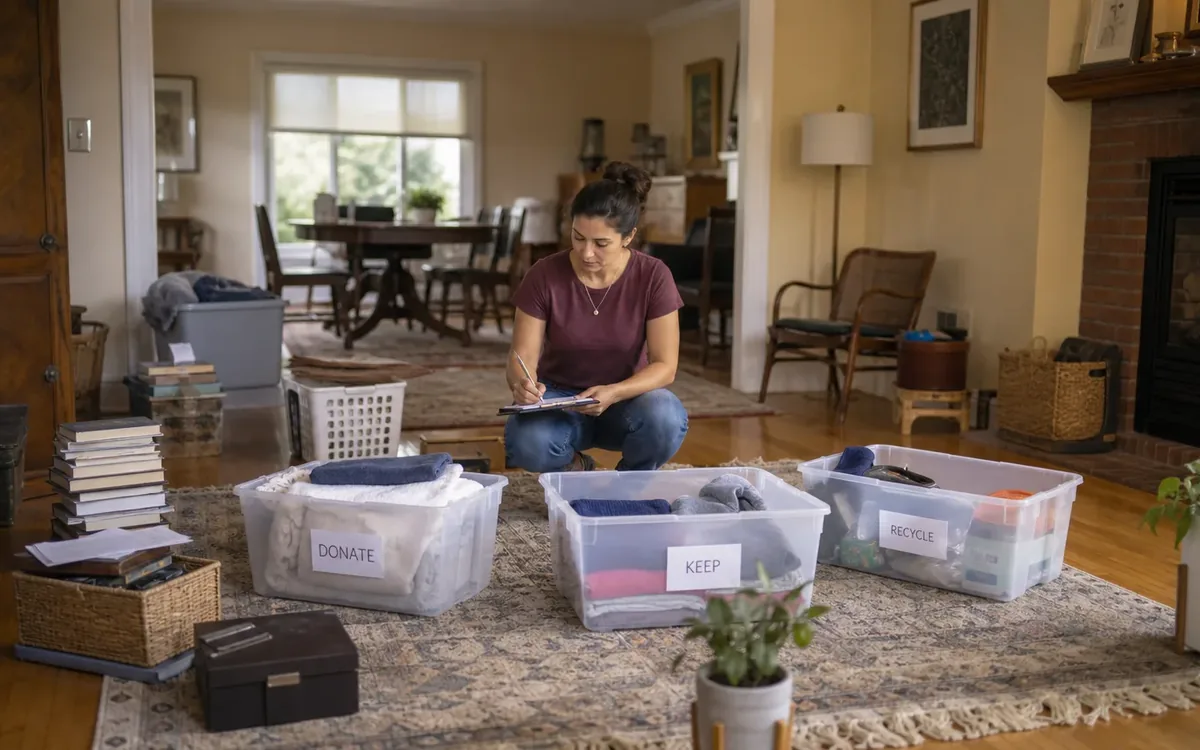
Before work begins, sort decisions into four groups:
- Remove: Items the authorized decision-maker has approved for disposal, donation, recycling, or another lawful destination.
- Retain onsite: Belongings that may remain in a location permitted by the relevant office.
- Move to separate storage: Property the household chooses to preserve through a storage provider under a separate arrangement.
- Hold for review: Documents, valuables, firearms, medication, hazardous material, disputed property, and anything subject to legal or professional direction.
Ask the local office whether moving a cited accumulation from one room, structure, or outdoor area to another would still leave the condition unresolved. Do not use a garage, shed, attic, yard, vehicle, or rented container as a default solution without confirming that it is lawful and appropriate.
Storage is a household decision arranged with a storage provider. Disposal methods depend on the item, local rules, facility acceptance, and any instructions in the notice. Hazardous, regulated, or unknown materials may require direction from the relevant authority or a qualified provider rather than ordinary hauling.
How should access be prepared for the inspector?
Ask what parts of the property must be visible and reachable. The household should not infer access standards from photographs or from a prior visit because the inspector may need to verify components that were previously blocked.
Confirm whether access is needed to:
- Entry doors and interior doors
- Corridors, stairs, and landings
- Utility shutoffs, meters, and service equipment
- Electrical panels or mechanical equipment
- Plumbing fixtures or sanitation facilities
- Windows or emergency openings
- Attics, crawl spaces, basements, garages, sheds, or outbuildings
- Exterior walls, fences, yards, and drainage areas
Ask whether animals must be secured and whether someone needs to provide keys or unlock gates. Also ask if occupied rooms will be entered and whether tenants or other occupants need formal notice. Questions about lawful entry, lease obligations, court authority, or required notice should go to the responsible legal professional or housing authority, not a cleanout team.
Do not remove covers, open walls, disconnect utilities, or disturb suspected hazardous material simply to improve visibility. The office or an appropriate licensed or qualified professional should explain how those areas are to be evaluated.
What can a practical cleanout or move team discuss?
A practical team can discuss the physical scope needed to make approved areas orderly and accessible. The conversation should focus on identifiable tasks rather than promises about inspection results.
Topics may include:
- Which rooms or exterior areas are included
- What the authorized household representative has approved for removal
- What must remain untouched
- How retained items will be grouped or relocated within the agreed scope
- Whether pathways and specified access points can be cleared
- How photographs or inventories will be handled if requested
- Which items require a separate provider or authority
- How new discoveries will be reported before additional action
The team may also flag conditions that interrupt work, such as unstable materials, unknown substances, active utilities, sharp objects, or disputed belongings. Flagging a concern is not an inspection or professional diagnosis.
Contractor repairs remain separate. Electrical, plumbing, structural, roofing, mechanical, pest, environmental, or permit-related work should be evaluated and completed by the appropriate provider when required. The local office decides whether resulting documentation and corrections satisfy the case.
Appraisals are separate as well. An appraiser or qualified valuation professional determines value for the relevant purpose. A cleanout team can set aside identified property, but it should not make binding valuation, tax, probate, insurance, or equitable-distribution decisions.
What should you confirm about scheduling and attendance?
Do not treat an informal conversation as a confirmed appointment. Ask the office how scheduling works and what notice will show that the reinspection is booked.
Confirm:
- The approved date and arrival arrangement
- Whether the office provides a window or requires another scheduling method
- The property address and case number
- The name and contact details of the onsite representative
- Whether the owner must attend
- Whether an agent needs written authorization
- How to report access problems or changed conditions
- What happens if work is incomplete when the visit occurs
If multiple departments are involved, ask whether each requires its own inspection. Approval from one office may not resolve a matter assigned to another. Likewise, a contractor’s completion statement is not automatically the same as municipal or county acceptance.
South Carolina properties may be governed by different municipal, county, state, association, court, or lease requirements. Use the contact information printed on the actual notice and verify that you are speaking with the office responsible for the case. Do not rely on a neighboring jurisdiction’s process.
What happens if a correction cannot be completed beforehand?
Tell the issuing office promptly and describe the unresolved item accurately. Ask what formal process applies rather than assuming that a verbal explanation, scheduled contractor, or partially cleared room will prevent further action.
Ask three direct questions:
- Does the office have a documented procedure for requesting more time or reporting a barrier?
- What information or supporting records must the responsible party submit?
- Will the reinspection proceed, be changed, or require a separate decision?
Only the authority handling the case can explain its enforcement process or approve an extension. A lawyer can advise on rights, liability, ownership disputes, court orders, appeals, or responses to enforcement. A qualified contractor can address work within that provider’s trade. A cleanout team can revise an agreed removal scope, but it cannot suspend enforcement or promise approval.
Be precise about barriers. “The property is not ready” is less useful than identifying that an ownership dispute prevents disposal, a permit is pending, a professional assessment is required, or a specific area remains inaccessible.
A focused pre-reinspection sequence
Use this five-step sequence to keep the project tied to the notice:
- Verify the authority and case. Contact the office named on the current notice and confirm the open items.
- Separate the work types. Divide belongings removal, disposal, storage, repairs, permits, professional reports, and legal questions.
- Assign each decision. The authorized household representative handles belongings; contractors handle their trades; appraisers handle valuation; legal professionals address legal issues; the authority determines compliance.
- Complete and document approved tasks. Keep records organized by cited item without altering or discarding evidence that should be preserved.
- Confirm the appointment and next step. Ask how the result will be communicated and whether anything else remains open.
This approach helps prevent a common problem: substantial cleaning occurs, but a narrow cited issue remains untouched because nobody confirmed what the inspector needed to see.
Questions to ask after the reinspection
Before the inspector leaves, ask how the outcome will be documented. The inspector may not be able to provide a final determination onsite, so learn where and when the official result will appear without assuming approval.
Useful questions include:
- Will the office send a written report or update an online case record?
- Which items, if any, remain open?
- Is another department’s approval still required?
- Are additional photographs, permits, invoices, or professional reports needed?
- Does the responsible party need to request another visit?
- Who should receive follow-up questions?
Keep the property stable until the official result is known. Avoid returning removed material to cited areas or blocking components that may need further review. Preserve the notice, communications, photographs, receipts, and reports with the property records.
Short FAQ
Can the local office tell me exactly what to throw away?
It can explain the cited condition and applicable process, but it may not decide ownership or select individual personal belongings for disposal. The authorized household representative should make property decisions, with legal advice when ownership or authority is disputed.
Does clearing clutter guarantee that the case will close?
No. Clearing approved items may improve access or address an accumulation, but closure depends on the authority’s findings and any remaining permit, repair, sanitation, zoning, or documentation requirements.
Should repairs be completed by the cleanout team?
Treat repairs as a separate scope. Ask the issuing office whether a particular trade, permit, inspection, or report is required, then use the appropriate qualified provider.
Can belongings be moved into storage before reinspection?
The household may choose storage if it has authority over the items, but it should confirm that removal from the cited area addresses the notice. Storage contracts, transport, access, and cost are separate household and provider decisions.
Who makes the final compliance decision?
The responsible government office, inspector, court, association, or other authority makes the decision within its jurisdiction. A cleanout provider can support physical preparation but cannot issue that determination.
Clutter Cleaner of South Carolina is physically based in Mount Pleasant and serves households statewide, with Charleston as its primary market. For a possible cleanout connected to a notice, call (843) 972-7020 to discuss the physical property scope after confirming the reinspection requirements with the responsible local office.



