

If you receive a municipal property maintenance notice in South Carolina, read it carefully, confirm which property and conditions it identifies, preserve a copy, and contact the issuing office through verified contact information. Then separate the household’s cleanup decisions from questions that require municipal direction or a qualified professional. Start with clear communication, not assumptions about what will satisfy the notice.
Many South Carolina towns issue notices concerning overgrown yards or exterior conditions. The notice itself, along with clarification from the issuing authority, should guide your response. A cleanout may help address accumulated belongings, but it does not automatically resolve vegetation, structural, permitting, or other compliance concerns.
Quick answer
- Save the notice, envelope, attachments, and any posted materials.
- Identify the cited conditions, response instructions, and stated deadlines.
- Photograph the conditions without disturbing unsafe materials.
- Verify the issuing office’s contact information and ask focused questions.
- Decide who can authorize access and removal of belongings.
- Arrange only the work you understand and are authorized to approve.
- Ask how to submit completion evidence and confirm whether the matter is closed.
What should you do when the notice arrives?
Begin by making a readable copy of every page. Keep the original somewhere it will not be packed, discarded, or mixed into household sorting. If the notice was posted outside, photograph it before moving it, provided doing so is safe and permitted.
Read for specifics rather than reacting to the overall tone. A notice may identify several conditions that need different responses. An accumulation of outdoor belongings, an overgrown area, and a damaged exterior feature should not be treated as one undifferentiated cleanup job.
Record the information that will help you communicate accurately:
- Property address and any case or reference number.
- Name of the issuing department or office.
- Description of each cited condition.
- Instructions for responding or providing evidence.
- Dates and deadlines printed in the notice.
- Contact information and any attached photographs.
If you received the notice while handling a move or estate, check that the person receiving it is also authorized to act for the property. Being a relative, occupant, or helpful neighbor does not by itself settle ownership or decision-making authority.
Do not ignore an approaching deadline while gathering information. Ask the issuing office what response is expected by that date. Questions about legal consequences, notice validity, or representation belong with a qualified attorney or the responsible authority, not a cleanout team.

How do you contact the municipality without making assumptions?
Verify contact details through an official municipal source before sharing sensitive information or making a payment. Then use the case number and property address to explain why you are calling or writing.
Keep the first conversation focused on understanding the notice. You do not need to make promises about work you have not evaluated. A useful opening is: “I received the notice for this property and want to confirm the cited conditions and the response process.”
Ask practical questions such as:
- Which specific areas or items does the notice concern?
- Is there a photograph or description that clarifies the issue?
- What information should the household provide in its response?
- How should completion be documented?
- Is a follow-up inspection required, and how is it requested?
- Who should receive questions about an unclear requirement?
If more time may be needed, ask about the municipality’s process for requesting it. Do not assume that making a request changes the deadline. Seek clear confirmation of any revised instructions, preferably in writing.
For help organizing the practical side of a response, review Clutter Cleaner of South Carolina’s code compliance support service. The company’s service territory includes all of South Carolina, with its physical business location in Mount Pleasant and Charleston as its primary market. Municipal officials, not the support team, determine whether the property meets the applicable requirements.
Build a response file that stays useful during cleanup
A simple response file prevents details from disappearing as belongings move and conditions change. It can be a paper folder, a shared digital folder, or both. Choose a format the responsible household members can actually maintain.
Take wide photographs showing the location of a cited condition and closer photographs showing its details. Keep original files when possible. Avoid entering unstable structures, climbing over piles, or handling unknown substances just to obtain a better picture.
Include these materials in the file:
- The notice and all attachments.
- Before photographs labeled by location.
- Copies of messages sent to and received from the municipality.
- Notes identifying the date, contact person, and substance of a conversation.
- The household’s approved work scope.
- Relevant provider records and after photographs.
Distinguish what someone said from what the household inferred. “The office requested photographs of the side yard” is more useful than “They said everything should be fine.” If instructions are unclear, ask for clarification rather than expanding a brief conversation into an assumed approval.
When inherited belongings are part of the problem, the guide to the best way to clean out an estate offers a relevant companion resource. Keep estate sorting decisions separate from the municipality’s requirements so that urgency does not erase ownership questions.
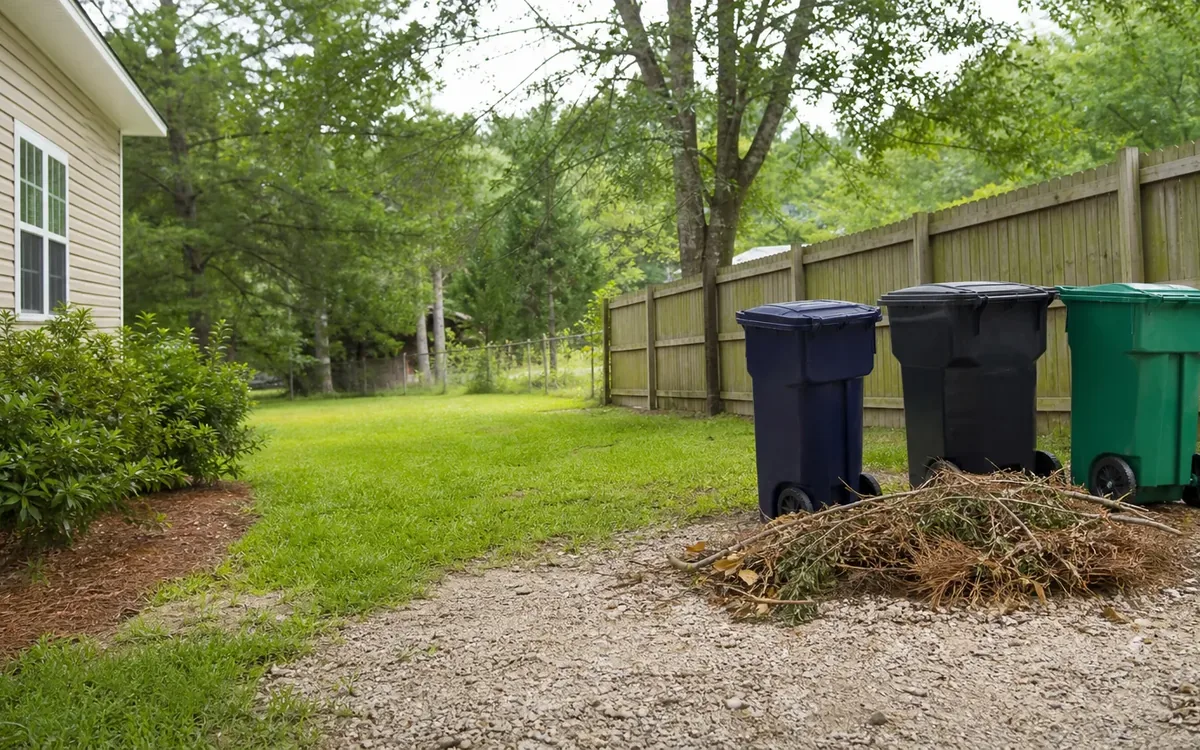
Separate cited conditions from household sorting decisions
A property notice can make every visible item feel urgent. Resist treating the whole property as disposable. Instead, connect each proposed action to a cited condition or to a separate household goal.
For example, outdoor furniture may be usable but located in an area identified in the notice. Moving it could be a household option, but only the issuing authority can clarify whether relocation addresses the concern. Likewise, clearing access to a fence does not resolve a question about the fence’s condition.
Use a working list with three categories:
- Notice-related conditions: The specific areas and issues described by the municipality.
- Household decisions: What to keep, relocate, evaluate, or authorize for removal.
- Professional questions: Matters involving repairs, safety, valuation, ownership, or compliance interpretation.
The household can establish protected areas and identify belongings that must not be removed. That might include documents, tools still in use, family possessions, or property belonging to someone else.
Potentially valuable items should not be assigned a value merely because they look old or collectible. An appraisal is a separate professional choice. Whether an item can be sold, transferred, or discarded may also depend on who owns it and who has authority to act.
This separation helps prevent unnecessary work. It also gives everyone a clearer explanation of why a particular action is being considered.
What can a practical cleanout or move team help discuss?
A practical team may discuss how belongings affect access, how sorting will be organized, and how an approved scope can be coordinated with other providers. The conversation should begin with the actual notice, not a broad request to “make the property compliant.”
Share the relevant pages, photographs, and municipal clarifications. Explain which decisions are settled and which remain open. A useful discussion covers:
- Areas where access is authorized.
- Belongings that must remain untouched.
- Who approves changes to the agreed scope.
- How uncertain items will be set aside for a decision.
- Access constraints and visible safety concerns.
- How household sorting fits around separately arranged work.
Ask what is included in a proposed service rather than assuming that every related task is covered. Storage, disposal arrangements, yard work, contractor repairs, and appraisal services are separate household or provider choices. Confirm responsibilities before authorizing activity.
Clutter Cleaner of South Carolina offers code compliance support, estate cleanouts, downsizing and organizing, move management, and home sale preparation. Those services do not replace municipal inspections, legal advice, or a contractor’s evaluation of repairs.
A practical plan should also explain what happens if the team encounters an unknown container, damaged structure, disputed possession, or another condition outside the agreed scope. Pausing for a responsible decision is preferable to improvising beyond the team’s role.
Keep authority and professional responsibilities clear
The household can decide its preferences for belongings and coordinate access, provided the person making those decisions has the necessary authority. It can also choose providers, approve a practical scope, and maintain communication records.
Other decisions remain outside that household planning role:
- Municipal authority: Explaining the notice’s requirements, directing the compliance process, and determining whether cited conditions are resolved.
- Legal professional: Advising on ownership disputes, estate authority, legal obligations, or consequences of the notice.
- Qualified contractor or inspector: Evaluating structural, electrical, or other technical conditions within their professional role.
- Appraisal professional: Providing an appropriate valuation when the household needs one.
- Real-estate professional: Advising on listing strategy and transaction-related matters.
A cleanout proposal is not a municipal approval. A contractor’s invoice is not necessarily proof that a case is closed. A real-estate plan does not remove the need to address the notice through the issuing office.
If authority is uncertain, resolve that question before allowing belongings to be removed. This is especially important when the property is part of an estate, occupied by someone other than the owner, or shared among decision-makers.
Document progress and ask how to close the matter
As authorized work proceeds, keep the response file current. Photograph the same areas from similar viewpoints so the change is easy to understand. Record any cited condition that remains unresolved rather than presenting partial work as full completion.
If the plan changes, communicate with the appropriate person. A new safety concern may require a qualified provider. A change affecting the response deadline or required evidence belongs in a conversation with the issuing office.
Before submitting completion materials, check the notice and any later instructions. Send only what the municipality requests through its stated process, and keep a copy of the submission.
Ask whether photographs are sufficient, whether an inspection is needed, and how the office communicates closure. If a case remains open, request a specific explanation of what still needs attention.
Do not assume silence means approval. Keep confirmation with the property records so it remains available during a later move, estate administration, or sale discussion.
Short FAQ
Does removing outdoor clutter automatically resolve a notice?
No. Removal may address one cited condition while vegetation, exterior damage, or another concern remains. The issuing authority determines whether the required conditions have been addressed.
Can a cleanout company negotiate legal issues for the household?
Practical support is different from legal representation. Ask the municipality about its response process and consult a qualified attorney for legal advice. Do not assume a service provider can act for the owner in every context.
What if the belongings belong to someone else?
Identify the owner and the person authorized to make decisions before removal. If ownership or authority is disputed, seek appropriate legal guidance rather than treating the notice as permission to discard possessions.
Who can help organize the practical response?
Clutter Cleaner of South Carolina can discuss its code compliance support and related cleanout or transition services. Call (843) 972-7020 with the notice available. Start by clarifying the practical scope, while leaving compliance determinations and specialized decisions with the responsible authority or professional.



