

The best way to plan debris removal after a property violation is to read the notice carefully, confirm what must be corrected with the issuing authority, document existing conditions, separate debris from property that must stay, and build the cleanup around safe access and the required correction. The household can organize possessions and choose cleanup help, but only the responsible authority can interpret the notice or confirm compliance.
Quick answer: Start with the written violation, not the debris pile. Identify the cited condition, contact the issuing office if the wording is unclear, photograph the property, protect important items, and define what can be removed. A practical cleanout or move team may discuss sorting, labor, access, hauling coordination, and donation options. Questions about law, permits, hazardous materials, repairs, boundaries, value, or final compliance belong to the appropriate authority or qualified professional.
What does the violation actually require?
A property violation may mention accumulation, blocked access, unsafe exterior conditions, inoperable items, overgrowth, structural deterioration, or another concern. Do not assume that removing every loose object will resolve it. The cited condition may also involve repairs, permits, inspections, sanitation, vegetation, vehicles, or building systems.
Read the entire notice and pull out these details:
- The property address and responsible party
- The condition or area identified
- Any ordinance or code section referenced
- Required corrective action, if stated
- A response, inspection, or compliance date
- Contact information for the issuing office
- Instructions for review, appeal, or reinspection
If the notice is unclear, ask the issuing authority focused questions. Which material is considered debris? Does the affected area need to be empty, merely accessible, or repaired? Is a follow-up inspection required? Are permits or separate agencies involved?
Clutter Cleaner of South Carolina can discuss practical cleanup planning through its code compliance support service. That discussion does not replace the authority’s interpretation, change a deadline, or guarantee that cleanup alone will satisfy the notice.

Build the plan around the cited condition
A useful debris-removal plan begins with the violation’s scope. It should not begin with a general decision to clear the whole property. A narrowly defined plan helps prevent accidental disposal and keeps labor directed toward the documented concern.
Use the following five-part sequence:
- Define the affected zone. Mark the yard section, room, access route, structure, or storage area named in the notice.
- Identify the blocking material. Distinguish loose debris and unwanted contents from fixtures, vehicles, building materials, and possessions requiring review.
- Establish access. Create a safe route for sorting and removal without moving questionable material unnecessarily.
- Schedule separate needs. Place repairs, inspections, specialty disposal, and legal questions outside the ordinary debris-removal scope.
- Document completion. Photograph the corrected area and retain hauling, donation, contractor, and communication records that may be useful.
This sequence keeps the plan tied to the cited issue. Broader decluttering can happen later unless it is necessary for access or correction.
What should stay out of the debris pile?
Items can look disposable while carrying financial, legal, sentimental, or compliance importance. Pause before removing anything that establishes ownership, identifies a product, supports an insurance matter, or may need professional evaluation.
Set aside:
- Deeds, notices, permits, surveys, tax records, and insurance documents
- Mail, photographs, identification, financial records, and family papers
- Keys, remotes, access cards, and labeled hardware
- Tools or materials that belong to a tenant, contractor, neighbor, or estate
- Objects with unclear ownership
- Potentially valuable collections, antiques, jewelry, or equipment
- Evidence related to damage, dumping, a dispute, or an insurance claim
- Materials that may require regulated handling
The household or authorized decision-maker determines what personal property can leave. An appraiser or qualified specialist should address uncertain value. An attorney, personal representative, landlord, property manager, insurer, court, or other responsible party may need to address authority and ownership.
When a violation affects an inherited home, the sorting principles in what happens if you get a code enforcement violation can help families avoid mixing estate decisions with routine debris removal. Estate authority and distribution questions still belong to the personal representative and appropriate legal adviser.
Separate removal from repair and compliance work
Debris removal, property repair, and compliance review are related but distinct tasks. Keeping them separate prevents a cleanup crew from being asked to make decisions outside its role.
Debris and contents
A cleanout team may discuss sorting, bagging, lifting, removal routes, vehicle access, donation candidates, and hauling logistics. The team can also flag objects that appear to need a household decision before removal.
Repairs and construction
Damaged fencing, unstable stairs, electrical problems, plumbing defects, roofing, structural deterioration, and building alterations belong to appropriate contractors. The contractor should determine methods and scope within that professional role. Permit requirements are decided by the relevant authority.
Specialty materials
Unknown chemicals, fuels, asbestos-containing material, medical waste, pressurized cylinders, biohazards, and certain electronics or batteries may require specialized evaluation or disposal. Do not place questionable material into an ordinary debris load until an appropriate provider or authority confirms how it should be handled.
Compliance decisions
The issuing department or responsible authority determines whether the cited condition has been corrected. A cleanup provider can document visible work but cannot issue legal clearance, waive requirements, extend deadlines, or promise that an inspection will pass.
How can you prevent accidental disposal?
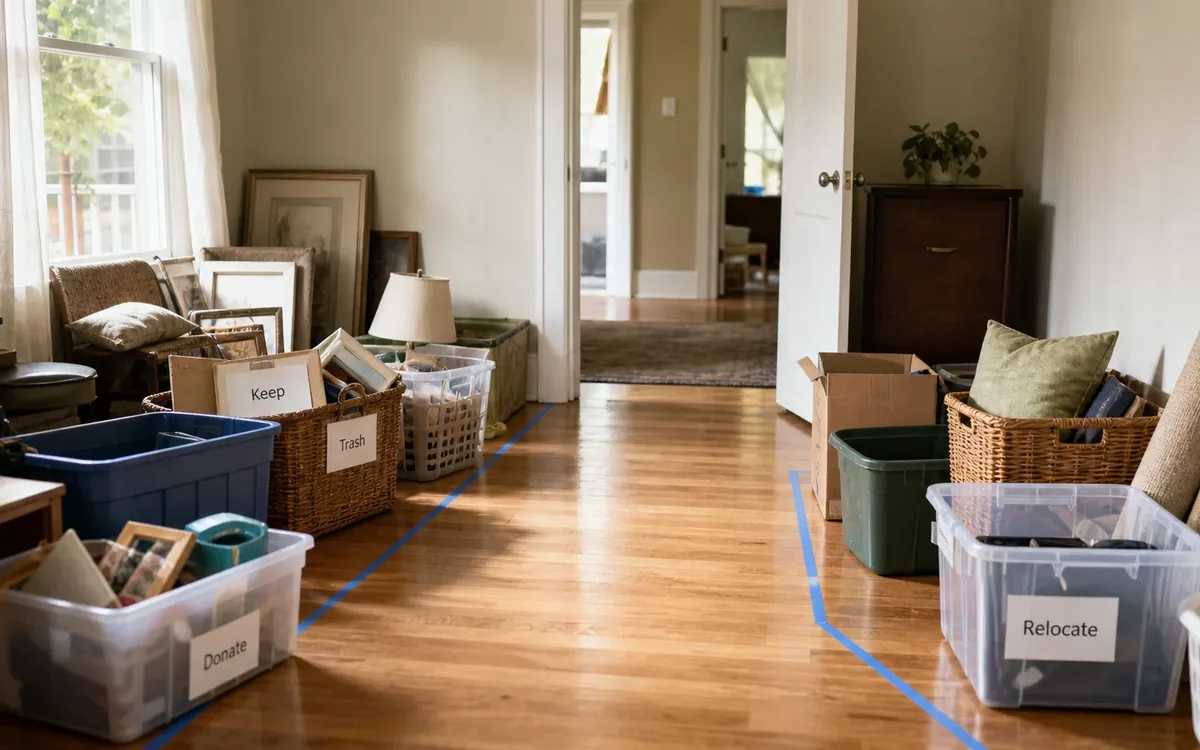
Use clear physical categories rather than relying on verbal instructions. Designate separate areas before removal starts, and make labels readable from the main work route.
Four categories are usually enough:
- Keep on property: Items that have a confirmed location and owner.
- Decision required: Documents, valuables, disputed objects, and anything with unclear ownership.
- Eligible to leave: Approved debris, trash, recycling, or donation candidates.
- Special handling: Material awaiting guidance from a contractor, disposal facility, environmental professional, or authority.
Assign one authorized person to answer item-level questions. If several relatives, owners, tenants, or managers give conflicting directions, pause removal from the disputed area until authority is clarified.
Take overview photographs before work and closer photographs of disputed or unusual items. Avoid publishing documents, identification, or private household details when sharing images. Store records where the authorized decision-maker can retrieve them.
Plan access before hauling begins
Poor access can turn a defined correction into a larger safety problem. Walk the intended removal path and identify unstable surfaces, low branches, loose railings, narrow gates, pets, traffic exposure, and areas that should remain closed.
Practical planning topics include:
- Where workers or helpers may enter
- Which route keeps debris away from occupied rooms
- Whether doors, gates, and elevators are available for authorized use
- Where removed material may be staged lawfully
- How vehicles can load without blocking emergency or neighboring access
- Which utilities, structures, or landscaping need protection
- Whether weather could make the route unsafe
A cleanout or move team may discuss labor flow and staging. Property owners or managers approve access. Contractors evaluate construction hazards. Public right-of-way use, container placement, street access, and similar permissions must be confirmed with the responsible authority rather than assumed.
Who should make each decision?
Clear roles reduce delays and conflicting instructions. Write down the decision-maker for every unresolved category before removal starts.
The household or authorized property representative
This person can identify possessions, approve ordinary disposal, select donation recipients, authorize access, choose providers, and retain records. That authority must be genuine, especially for estates, rentals, jointly owned property, or court-involved situations.
A practical cleanout or move team
The team may discuss the physical sequence of sorting and removal, needed access, items requiring a decision, basic staging, hauling coordination, and whether the planned scope is workable. It should not interpret ordinances or decide ownership.
The issuing authority
The appropriate office explains its notice, applicable process, inspection procedure, and compliance determination. Only that authority can confirm whether its requirements have been met.
Other responsible professionals
Attorneys address legal authority and disputes. Appraisers or qualified buyers evaluate uncertain value. Real-estate professionals advise on marketing and transaction priorities. Inspectors report within their inspection scope. Contractors evaluate and perform trade work. Specialty providers address regulated or hazardous materials. Storage companies set their own acceptance terms and access policies.
Coordinate the cleanup without expanding it unnecessarily
A property violation can create pressure to solve every household issue at once. That approach often creates more decisions than the cited correction requires. Keep the first phase focused on access, safety, and the condition described in the notice.
Before work begins, prepare a written scope containing:
- The exact work area
- The material already approved for removal
- Protected items and no-entry spaces
- The person authorized to make decisions
- Unresolved specialty or ownership questions
- Required contractor tasks
- Known access restrictions
- The documentation to retain
If sale preparation, downsizing, organizing, an estate sale, or a larger move is also needed, treat it as a separate phase. This preserves the compliance focus and allows each decision to be made for the right reason.
Storage should also be a deliberate household choice, not a default destination for everything uncertain. Confirm what will be stored, who may access it, how long the household wants to retain it, and what the chosen storage provider accepts. A cleanout plan can account for a storage destination, but the storage contract and long-term decisions remain with the household and provider.
Document work for a follow-up conversation
Good documentation creates a clear record, but it does not prove legal compliance by itself. Capture the condition before removal, the work area after removal, and any issue that could not be addressed.
Retain:
- The original notice and related correspondence
- Dated photographs showing consistent viewpoints
- Written disposal approvals from the property decision-maker
- Donation or disposal receipts when provided
- Contractor records for separate repair work
- Notes from conversations with the issuing office
- Inspection or reinspection communications
Ask the authority how completion should be reported. Some situations may require a scheduled inspection, submitted records, or another specific process. Do not assume that photographs, receipts, or a clean appearance close the matter.
If new damage becomes visible after debris is removed, document it and route it to the appropriate professional. For example, a contractor can assess deterioration, an inspector can report observed conditions within scope, and an insurer can explain claim requirements. A debris-removal team should not diagnose the cause or certify the repair.
What if the property involves an estate, tenant, or absent owner?
These situations require extra attention to authority. The person present at the property may not have the right to discard every item.
For an estate, confirm the authorized representative and protect records, valuables, and beneficiary property. For a rental, separate owner property from tenant possessions and obtain appropriate guidance before disposal. For an absent owner, use written instructions and a clear approval process for exceptions.
Do not use a code notice as automatic permission to discard another person’s belongings. Ownership, notice requirements, probate responsibilities, lease questions, and abandoned-property decisions can involve legal rules. Those questions belong to a qualified attorney or the responsible authority.
Clutter Cleaner of South Carolina is physically located in Mount Pleasant and works statewide across South Carolina, with Charleston as its primary market. The company may discuss available code compliance support, estate cleanouts, downsizing and organizing, auctions and estate sales, move management, and home sale preparation when relevant. Availability and scope should be confirmed directly for the specific property.
Short FAQ
Should everything outside be removed after a violation?
Not automatically. Remove only material the authorized decision-maker has approved and that fits the correction plan. Confirm ambiguous notice language with the issuing authority, and separate vehicles, fixtures, construction materials, disputed property, and specialty waste for proper review.
Can a cleanout company confirm that the property is compliant?
No. A cleanout company can describe completed removal and provide available work records. The responsible government office or other issuing authority determines compliance and closes its case according to its process.
Should potentially valuable items be donated or discarded?
Pause first. The household may keep, donate, sell, or discard property it has authority to control. When value is uncertain, consult an appraiser, qualified buyer, auction professional, or estate-sale provider before disposal.
What if repairs are discovered during debris removal?
Photograph the condition, restrict access if needed, and consult the appropriate contractor or inspector. Building, electrical, plumbing, structural, and similar work should remain separate from ordinary removal. The relevant authority determines whether permits or further inspections are required.
Where should planning begin in South Carolina?
Begin with the written notice and the office that issued it. Then identify an authorized household decision-maker and define the physical cleanup scope. To discuss practical support with Clutter Cleaner of South Carolina, call (843) 972-7020 while keeping legal, repair, appraisal, inspection, and compliance decisions with the appropriate professionals.



