

Before yard cleanup begins, photograph the work area from several angles, mark uncertain items on a simple site sketch, record written instructions, and pause work near any disputed boundary. This documentation can clarify the intended cleanup scope, but it does not establish legal ownership or replace a survey, title review, inspection, permit decision, or advice from the responsible authority.
Quick answer: Create a dated visual record of fences, plants, debris, drainage features, structures, and access routes near the shared edge. Label what may be removed, what must remain, and what needs professional clarification. If the actual property line or ownership of an item is uncertain, keep it outside the cleanup scope until the appropriate surveyor, attorney, owner, association, utility, or public authority addresses the question.
This approach applies across South Carolina, especially where fences, vegetation, drainage areas, or discarded materials make a yard-cleanup boundary difficult to interpret. It focuses on documenting conditions and instructions, not deciding where a legal boundary lies.
Why document the boundary area before cleanup?
Yard cleanup can change a property’s appearance quickly. Once a pile is hauled away, vines are cut, or a leaning panel is moved, it may be difficult to reconstruct what was present or where it sat.
Documentation gives the household and cleanup team a shared reference. It can show:
- Existing conditions before anyone moves material
- The location of fences, walls, hedges, trees, and drainage features
- Items approved for handling
- Areas intentionally excluded from the work
- Access routes that avoid neighboring land
- Questions that still require an answer
This is particularly useful when preparing a property for sale, resolving an exterior code concern, managing an estate, or coordinating work for an absent owner. Clutter Cleaner of South Carolina offers code compliance support for cleanup planning statewide, but the relevant authority determines whether a property complies with a notice, ordinance, or other requirement.
Documentation is not proof that a fence follows the surveyed line. It also does not determine who owns a tree, retaining wall, shed, or pile of material. Its purpose is narrower: to preserve visible facts and define what workers have been authorized to touch.
What should appear in boundary-area photographs?
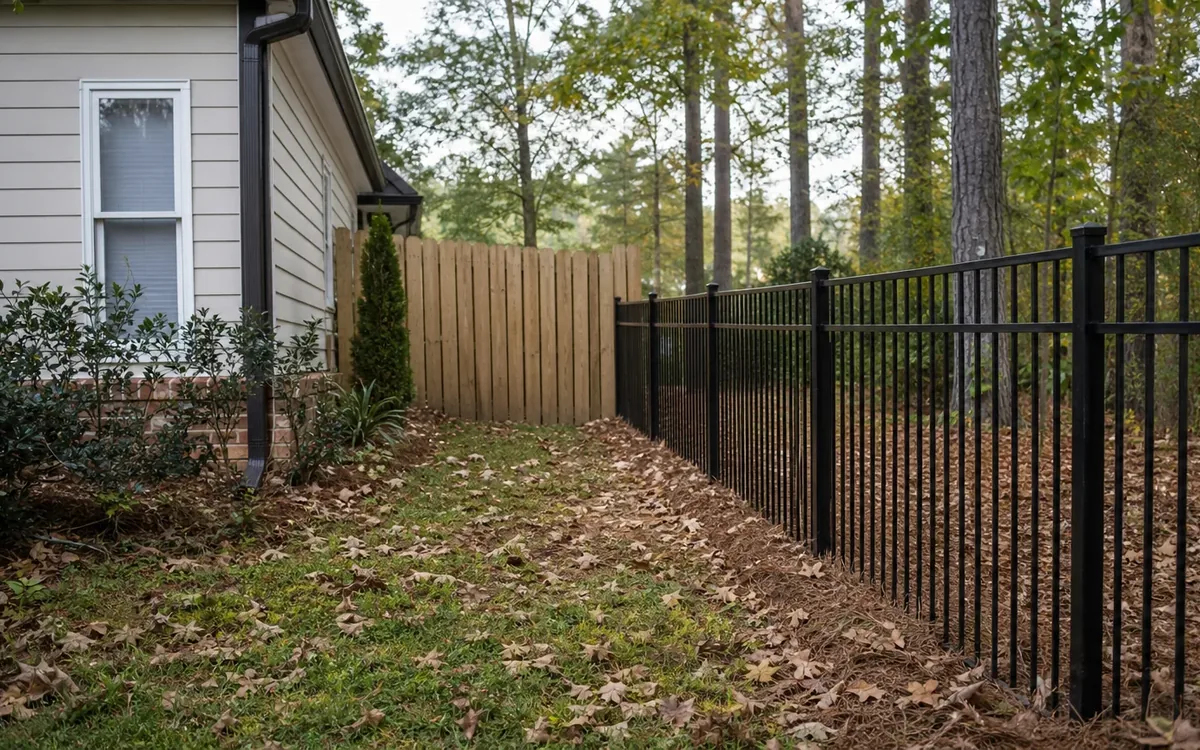
A useful photo set moves from broad context to close detail. Avoid taking only tight pictures of individual objects, since those may not show where each object is located in relation to the house, street, fence, or adjoining lot.
Capture these six views:
- An overview from each end of the boundary area. Include fixed reference points such as the home, driveway, fence corners, or outbuilding.
- A straight-on view of the shared edge. Photograph visible fences, hedges, walls, ditches, or changes in ground cover without claiming that they define the legal line.
- Close views of cleanup items. Record branches, leaves, containers, scrap, furniture, loose fencing, and other material under consideration.
- Vegetation at or across the visible edge. Include trunks, root zones, limbs, vines, shrubs, and planted beds that could be affected.
- Drainage and utility features. Photograph swales, grates, culverts, meters, boxes, poles, marked lines, and areas where water appears to travel.
- The proposed access path. Show gates, side yards, pavement, lawn surfaces, low branches, and narrow turns that workers or equipment might encounter.
Keep original images when possible. Cropping or marking a copy can help explain the scope, while the unedited version preserves the full scene. Use consistent file names such as “north-fence-overview” or “debris-near-rear-corner” rather than relying on a long stream of unlabeled photos.
A short video walkthrough can add context, but it should supplement rather than replace still photographs. Move slowly, name the area being shown, and avoid narrating uncertain ownership as fact.
How can a household create a practical boundary sketch?
A sketch does not need to be a survey-quality drawing. It only needs to help the people involved connect instructions with visible locations.
Start with the footprint of the house and add obvious fixed features: driveway, street, gates, fences, sheds, patios, large trees, drainage channels, and utility equipment. Then divide the cleanup area into labeled zones, such as:
- Zone A: debris clearly inside the approved work area
- Zone B: vegetation to remain untouched
- Zone C: uncertain strip requiring clarification
- Zone D: approved access route
- Zone E: materials to be evaluated separately
Use neutral labels. Write “visible fence” instead of “property line” unless a qualified source has established that relationship. Likewise, “debris beside fence” is safer and more precise than “neighbor’s debris” when ownership is unknown.
Match the sketch labels to photo names. For example, a circle marked “C2” can correspond to photographs titled “C2-wide” and “C2-detail.” This creates a simple record that another family member, property representative, or work team can understand without guessing.
If the yard cleanup is part of a larger transition, the guide to how estate cleanouts work explains broader sorting and decision roles. Outdoor boundary questions should still remain separate from decisions about interior contents.

Who decides what can be removed near a shared edge?
The household or authorized property representative can decide what work it wants completed on property and items it has authority to control. It can also set conservative instructions, such as excluding an uncertain strip or requiring approval before handling a specific object.
A practical cleanout or move team may discuss:
- The visible work area and requested outcome
- Which materials are included or excluded
- Safe access for workers and vehicles
- Whether an item appears attached, embedded, heavy, unstable, or mixed with vegetation
- Whether the scope should pause pending clarification
- How approved items will be sorted for the chosen next step
Those discussions do not establish title, property lines, easements, rights to trim, or responsibility for drainage. When authority is unclear, the practical response is to stop at the uncertain area and refer the question to the appropriate party.
Depending on the issue, that party may be:
- A licensed surveyor for locating or marking a property boundary
- A South Carolina attorney for ownership, access, easement, estate-authority, or dispute questions
- An appraiser for value opinions
- A real-estate professional for listing strategy and transaction coordination within that professional’s role
- A qualified inspector or contractor for structural, drainage, fencing, tree, or site conditions
- A utility provider before work near utility infrastructure
- A municipality, county, association, or other responsible authority for applicable rules and approvals
A neighbor’s informal agreement may be helpful for communication, but it is not a substitute for professional clarification when legal rights are disputed or uncertain.
What details belong in written cleanup instructions?
Written instructions should describe observable items and actions. They should not rely on broad phrases such as “clear everything along the fence,” which can create confusion around plants, attached materials, or objects extending across the visible edge.
Include the following:
- Property address and name of the authorized contact
- Date the conditions were documented
- Sketch and corresponding photo labels
- Clearly included zones
- Clearly excluded zones
- Specific items approved for removal
- Specific items that must remain
- Instructions for mixed or concealed piles
- Approved gates, driveways, or paths
- Stop-work questions and the person authorized to answer them
- Any known restrictions communicated by the responsible authority or professional
Use item-level language where needed. For example: “Remove loose bags and broken plastic containers in Zone A. Do not cut vines, move fence sections, enter Zone C, or disturb the drainage grate.”
If instructions change, document the revision rather than relying on memory. Identify what changed, who authorized it, and which photo or sketch area it affects. Keep superseded notes so the progression remains understandable.
What boundary features deserve extra caution?
Some exterior features are easy to misread. Their physical position may not reveal ownership, responsibility, or the right to alter them.
Fences and walls
A fence may be inside one lot, shared, misaligned, or unrelated to the surveyed boundary. Do not use its appearance alone to decide ownership. Loose boards and leaning panels may also present contractor or safety questions beyond ordinary debris handling.
Trees, shrubs, and vines
Branches may cross a visible edge while trunks or roots are elsewhere. Cutting can affect plant health, neighboring improvements, or utility lines. A qualified tree professional, attorney, owner, or authority may need to address questions outside straightforward cleanup.
Drainage areas
Leaves and debris may collect in a swale, ditch, grate, or low point, but altering grade, blocking flow, excavating, or changing drainage is different from removing approved loose material. Drainage design and compliance belong with qualified contractors, inspectors, engineers, associations, or public authorities as applicable.
Mixed piles
A single pile may contain household debris, soil, limbs, construction material, chemicals, or items belonging to different people. Photograph layers as they become visible, and pause if newly exposed contents fall outside the approved scope. Disposal options remain separate choices subject to material type, facility rules, and applicable requirements.
Sheds, playsets, and attached objects
Structures and anchored objects should not be treated as loose debris. Removal may involve ownership, utilities, permits, contractor work, or inspection questions. Keep them out of the cleanup scope unless the responsible people and professionals have addressed those issues.
How should uncertainty be marked for the work team?
Make uncertain areas obvious both on paper and at the property. A sketch alone may be overlooked once work starts, while physical markers alone may be moved or misunderstood.
Use three layers of communication:
- Mark the plan. Shade excluded or pending zones and connect them to labeled photographs.
- Identify the area on site. Use a temporary, non-damaging visual cue that does not claim to be a survey marker or interfere with utilities, access, or public space.
- Review the stop point. Before work begins, confirm what condition requires the team to pause and whom it should contact.
Do not move survey monuments, utility markings, stakes, or official notices. Do not place stakes into the ground where utilities or other hazards may be present. If an official marking is needed, the appropriate surveyor, utility, contractor, or authority should handle it.
A “do not touch” zone can be more useful than trying to resolve every issue during the cleanup. It allows clearly authorized work to proceed while preserving the disputed or uncertain condition for proper review.
Keep cleanup choices separate from professional decisions
Boundary documentation supports coordination, but several related decisions belong in separate channels.
The household or authorized representative chooses the desired cleanup result, identifies items it controls, approves access, and decides whether to postpone uncertain work.
A cleanout or move team may discuss practical sorting, access, handling constraints, photographs, excluded areas, and how to organize the approved scope. It should not declare a legal boundary or resolve a title dispute.
Storage providers determine their acceptance terms and facility requirements. The household chooses whether approved movable property should go into storage.
Disposal facilities and specialized vendors decide what materials they accept and under what conditions. Hazardous, regulated, construction, or unknown materials may require a separate provider or authority.
Contractors and inspectors address work or condition questions within their qualifications, such as unstable fencing, tree risks, drainage, demolition, grading, or repairs.
Appraisers provide value opinions. A cleanup company should not decide whether an exterior object has financial, collectible, salvage, or real-property value.
Real-estate professionals advise on marketing and transaction considerations within their role. They do not replace a surveyor or attorney for boundary and ownership questions.
Attorneys, surveyors, associations, utilities, and government authorities address legal rights, official lines, recorded restrictions, utility requirements, permits, notices, and compliance determinations within their respective authority.
Keeping these roles distinct prevents a practical cleanup plan from being mistaken for legal or technical approval.
Final pre-work review
Before anyone starts moving outdoor material, compare the current conditions with the photos and sketch. Weather, animals, landscaping activity, or another person’s actions may have changed the scene since it was documented.
Confirm these five points:
- The person approving the work has authority to do so.
- The included and excluded zones remain visible and understandable.
- Access does not require entering an unapproved area.
- Attached, hazardous, disputed, or newly discovered materials have a stop-work instruction.
- Questions outside the cleanup team’s role have been referred to the appropriate professional or authority.
Keep the final photo set, sketch, written scope, and revisions together. Documentation cannot prevent every disagreement, but it can show what was visible, what was communicated, and what remained intentionally untouched.
FAQ
Does a fence prove where the property line is?
No. A fence is a visible reference feature, not automatic proof of the legal boundary. A qualified surveyor can address line location, while an attorney can address related legal questions.
Can cleanup proceed while a boundary question is unresolved?
The household may choose to limit work to a clearly authorized area and exclude the uncertain zone. Whether that is appropriate depends on site conditions, access, safety, and any applicable notice or requirement.
Should neighboring property be photographed?
Focus on the work area and features needed to explain the cleanup scope. Avoid unnecessary intrusion. If a dispute or legal concern exists, ask the appropriate attorney or authority how documentation should be handled.
Who decides whether cleanup satisfies a code notice?
The municipality, county, association, court, or other responsible authority determines compliance with its requirements. A cleanup team can help organize work around the communicated scope but cannot guarantee or declare compliance.
Can Clutter Cleaner determine who owns debris near a boundary?
No. Clutter Cleaner of South Carolina can discuss practical cleanup scope and documentation. Ownership, title, boundary, appraisal, and legal determinations stay with the responsible owners, professionals, or authorities.



